
Most store owners hear “order bump” and assume they need a dedicated funnel plugin. If you already use Advanced Coupons Premium, you can build a similar checkout offer with coupon features you may already have.
A WooCommerce order bump can help increase average order value by offering a small, related add-on to someone who has already decided to buy. The key is making the offer easy to understand and showing it only when it makes sense.
This guide covers what a WooCommerce order bump is, how it differs from an upsell, and how to recreate the core mechanic with Advanced Coupons when that setup fits your checkout.
What Is An Order Bump?
An order bump is a small, optional add-on offer shown at checkout, after the shopper has chosen their main purchase but before they pay. It is designed to be accepted or ignored in a single click, without leaving the checkout page.
The defining features are the timing and the size. It appears at the moment of commitment, and it asks for a fraction of what the shopper is already spending. A $9 add-on against a $60 cart is a much smaller decision than a $40 add-on. As the bump price climbs, the offer starts to feel less like a quick add-on and more like a separate purchase.
Order bumps are common on course platforms and funnel builders, which is where most store owners first encounter the term. The mechanic itself is not platform-specific, though, and nothing about it requires software built for funnels.
Order Bump Vs Upsell Vs Cross-Sell
These three get used interchangeably and they are not the same thing. The difference is when the offer appears and how much thinking it requires.
| Order bump | Upsell | Cross-sell | |
|---|---|---|---|
| When it appears | At checkout, before payment | After the main choice | Alongside the product |
| What it offers | Small, low-friction add-on | Higher-tier version of the same thing | Complementary product |
| Typical price | Well below cart value | Above the original | Similar or below |
| Decision effort | One click | Requires comparison | Requires browsing |
| Risk if done badly | Slows checkout | Feels pushy | Distracts from the sale |
An upsell asks the shopper to reconsider what they chose. An order bump leaves the original decision alone and adds a small related offer, so it usually asks for less deliberation. If you want the broader picture on the other two, our guide to upselling strategies covers them properly, and there are worked examples in coupon upselling and cross selling examples.
Why Order Bumps Lift Average Order Value
At checkout, the shopper has already decided to buy. A small, relevant add-on can be easier to consider because it does not ask them to revisit the main purchase.
Three things make the mechanic effective:
- The decision is already made. You are not convincing someone to buy. You are asking whether they also want the small thing next to it.
- The price anchor is favorable. Against a cart they have accepted, a low-value add-on reads as minor.
- There is no navigation. Nothing takes the shopper away from checkout, so there is no new opportunity to abandon.
The flip side is that a badly chosen bump can add friction. Anything that requires extra thought at checkout competes with completing the order, especially if the shopper has to stop and compare options.
Order Bump Examples That Work
The best bumps are obvious. The shopper should understand the offer without reading twice.
- The consumable partner. Something the main product uses up. Filters, refills, blades, batteries.
- Protection or care. A cleaning kit, a case, an extended-care product. Low cost, clearly related.
- The smaller sibling. A travel size or single unit of the item already in the cart.
- Gift wrapping or presentation. Especially strong in the run-up to a gifting season.
- A digital add-on. A guide, template, or care instructions. No fulfillment cost.
What tends not to work: anything at a similar price to the main item, anything requiring a size or color choice, and anything unrelated to what is already in the cart.
How To Build A WooCommerce Order Bump
Advanced Coupons does not include a feature labeled “order bump,” but you can recreate the core setup by combining Add Products with cart conditions and a coupon trigger.
If you want order bumps as a native checkout feature, a dedicated funnel plugin is the cleaner route. We use FunnelKit for checkout on our own store, and it includes purpose-built order bump templates and split testing. We also wrote up what that was actually like to use. If you already use Advanced Coupons Premium, the setup below shows how to build a similar offer with the coupon tools you already have.
The relevant feature is Add Products, part of Advanced Coupons Premium. It lets a coupon add specified products to the cart when the coupon is applied, at a price you control. Combined with cart conditions and either One Click Apply or Auto Apply, you can control which carts qualify and how the coupon is triggered.
For this setup, Add Products, One Click Apply, and Auto Apply are Premium features. The free plugin includes six cart condition types, including Cart Subtotal, Cart Quantity, and Product Categories Exists In Cart. Premium adds sixteen more condition types.
Step 1: Set up the Add Products table
Create a coupon as usual, then give it a clear code and description so you can easily recognize the offer. For this example, we’re using FREECAT2026 to offer a free Cat Tote Bag when the cart qualifies.
In the coupon editor, open the Add Products panel and switch on Enable Add Products first. For each product you want the coupon to add, set the product, the quantity, and how it should be priced.
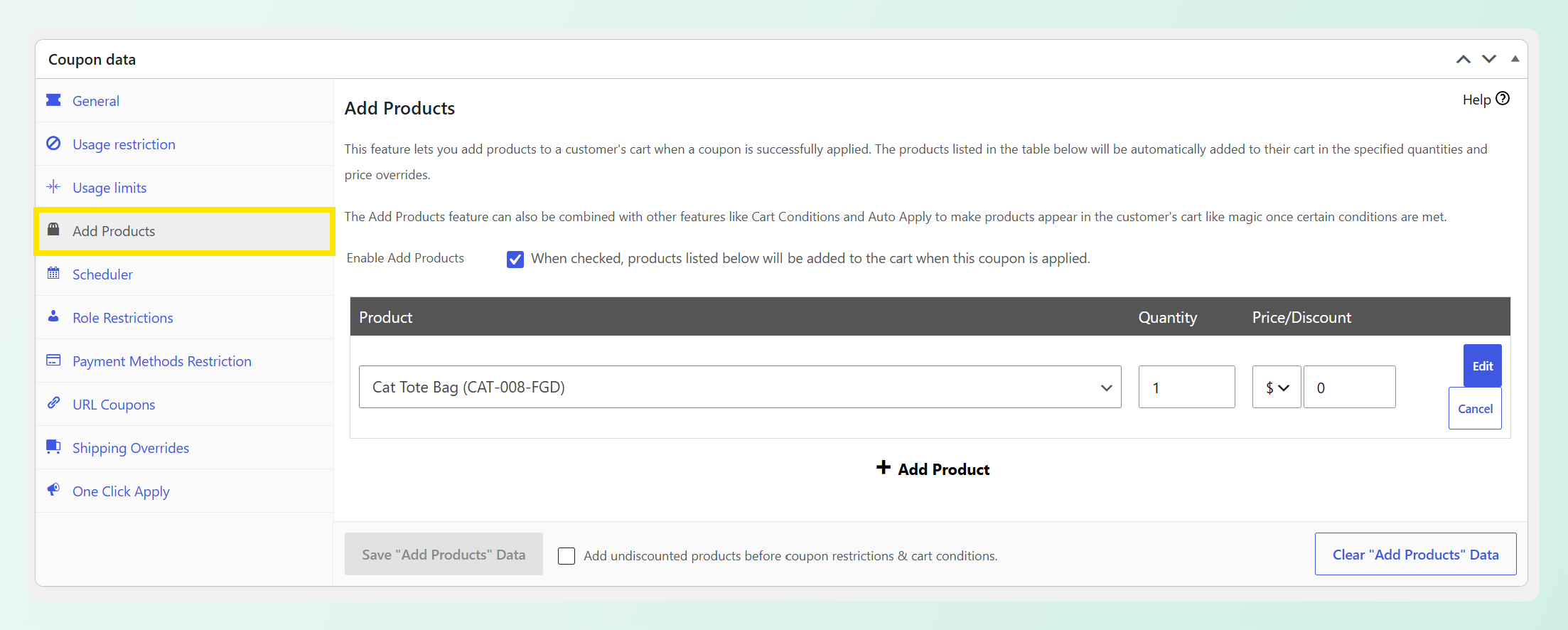
There are four pricing options: No discount, Fixed discount, Percentage discount, and Override price. Override is usually the right one for a bump, because it lets you state a flat bump price rather than expressing it as a discount off something else.
Both simple and variable products are supported, including specific variations, so you can bump one particular size or color.
Step 2: Set the bump price
Override price works well when you want the bump to have a fixed final price. Percentage discount is useful when you want the offer to adjust as the product price changes.
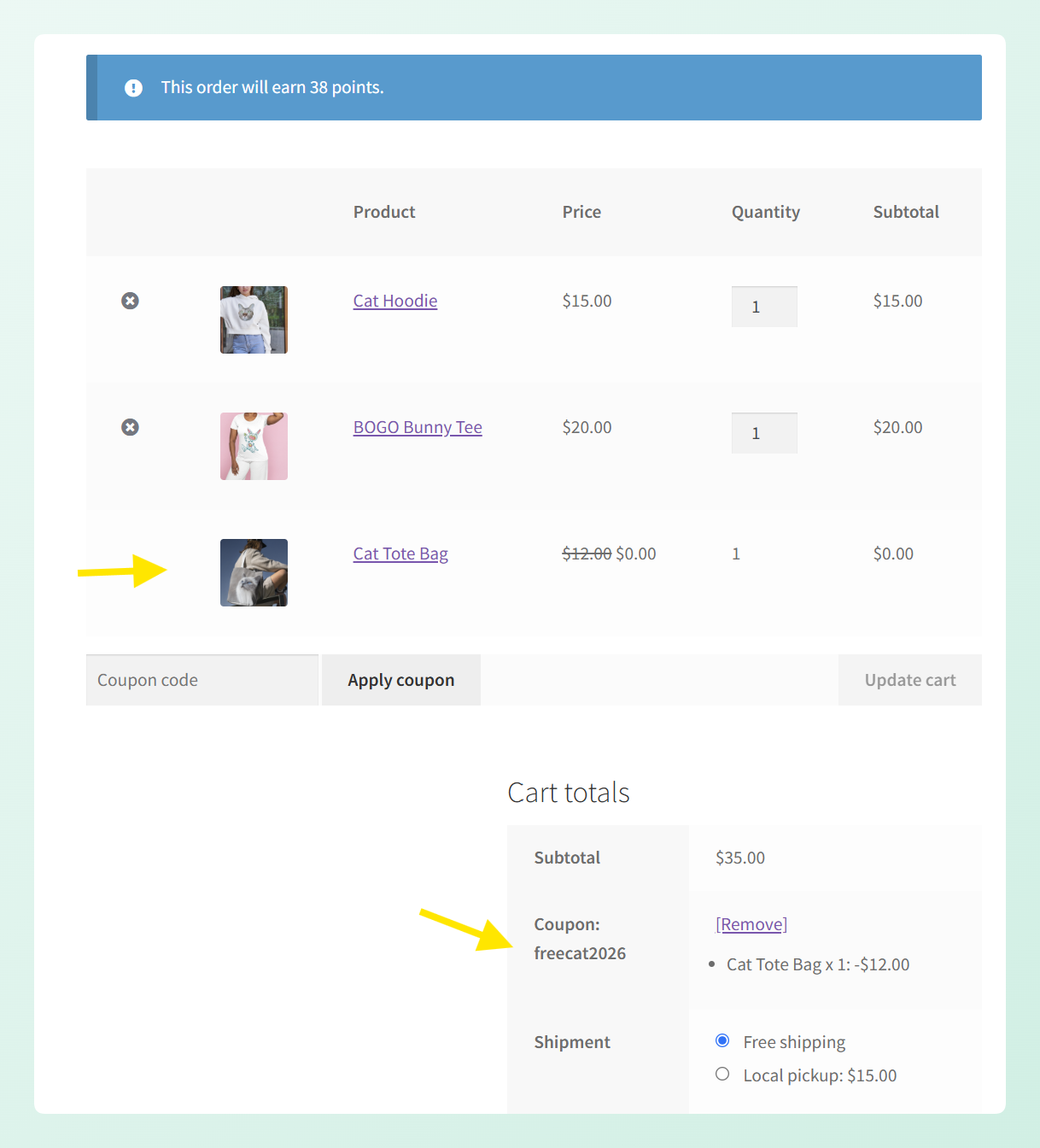
For this example, we’ve set the Cat Tote Bag to use an override price so it can be added as a free item when the shopper claims the coupon.
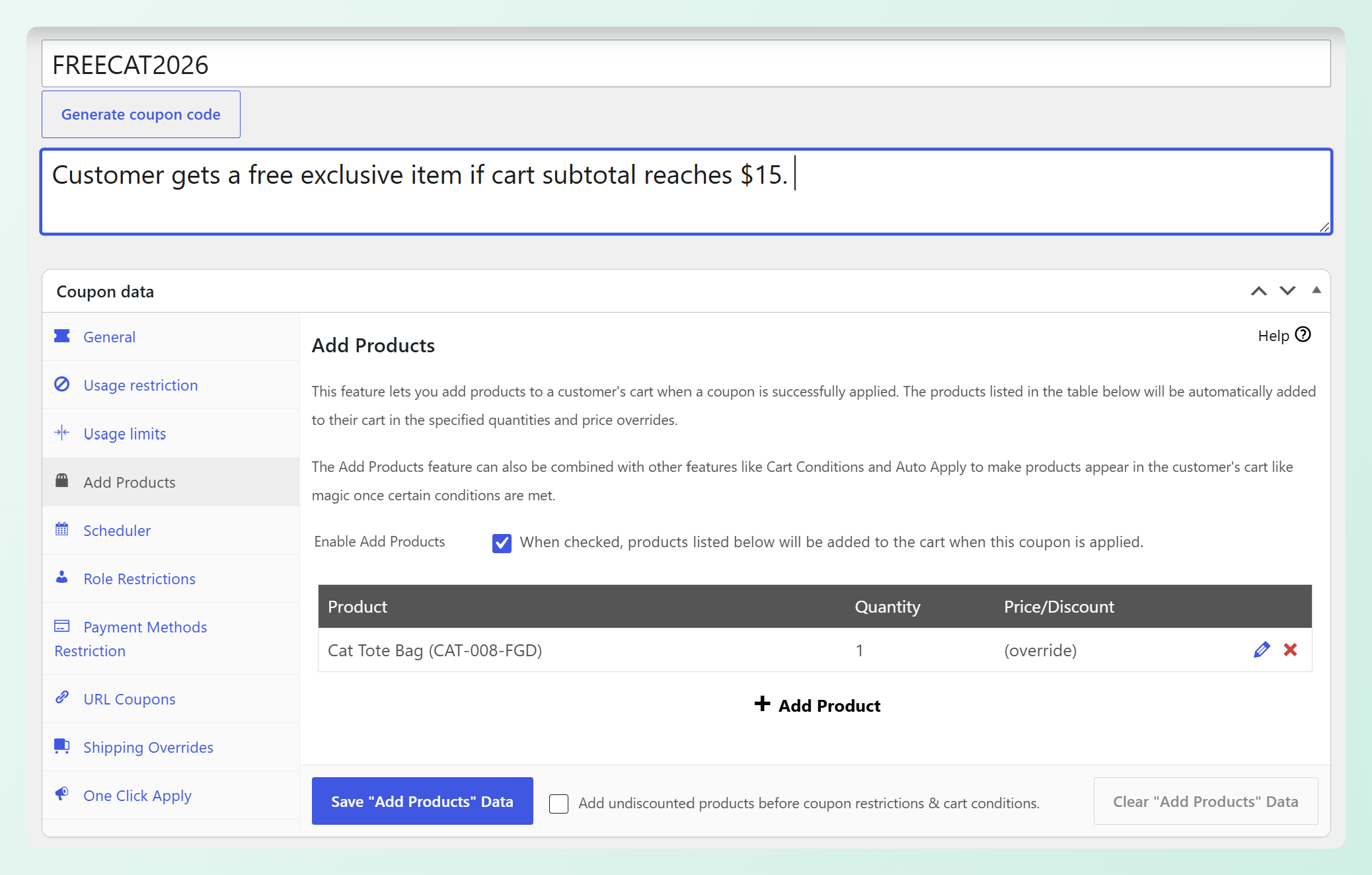
Use No discount only if you want to add the product without changing its price.
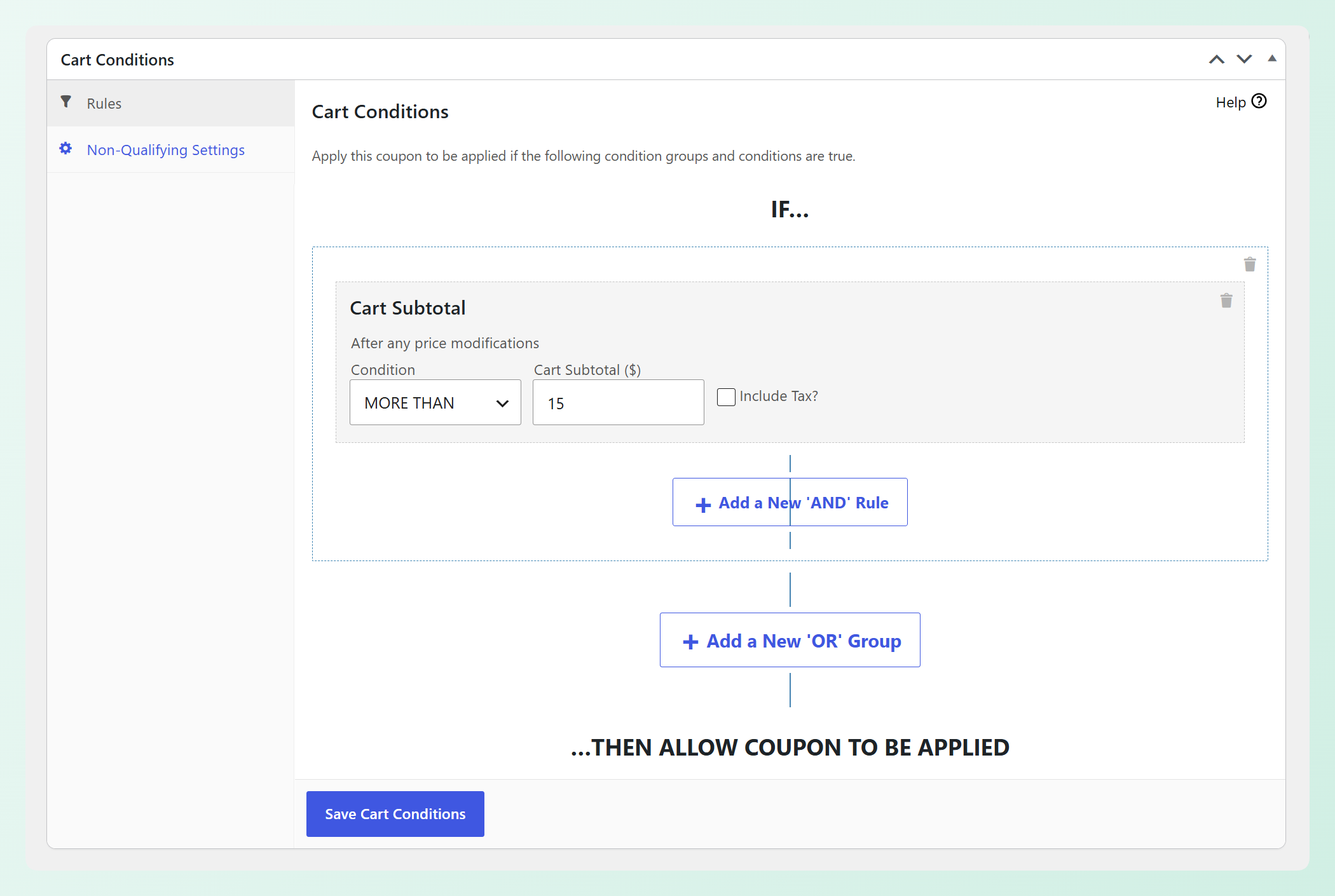
Step 3: Add a cart condition to keep the offer relevant
Cart conditions let you limit the offer to carts where it makes sense.
Useful conditions for a bump: Cart Subtotal, so the add-on is proportionate. Product Categories Exists In Cart, so the bump is genuinely related. Cart Quantity, if the bump only makes sense above a certain size. Those three are all in the free plugin. To target one specific product rather than a whole category, you want Product Quantity In The Cart, which is one of the Premium conditions.
In the example below, we’ve set Cart Subtotal to MORE THAN $15. This means the coupon only becomes available once the shopper’s cart passes that amount.
Step 4: Decide whether the shopper opts in
There are two ways to trigger the coupon, and they create different shopper experiences. One Click Apply shows qualifying shoppers a notice with an apply button, so they choose whether to apply the coupon and add the configured product. Auto Apply applies the coupon as soon as the cart qualifies, so the Add Products item is inserted automatically. Both are Premium features.
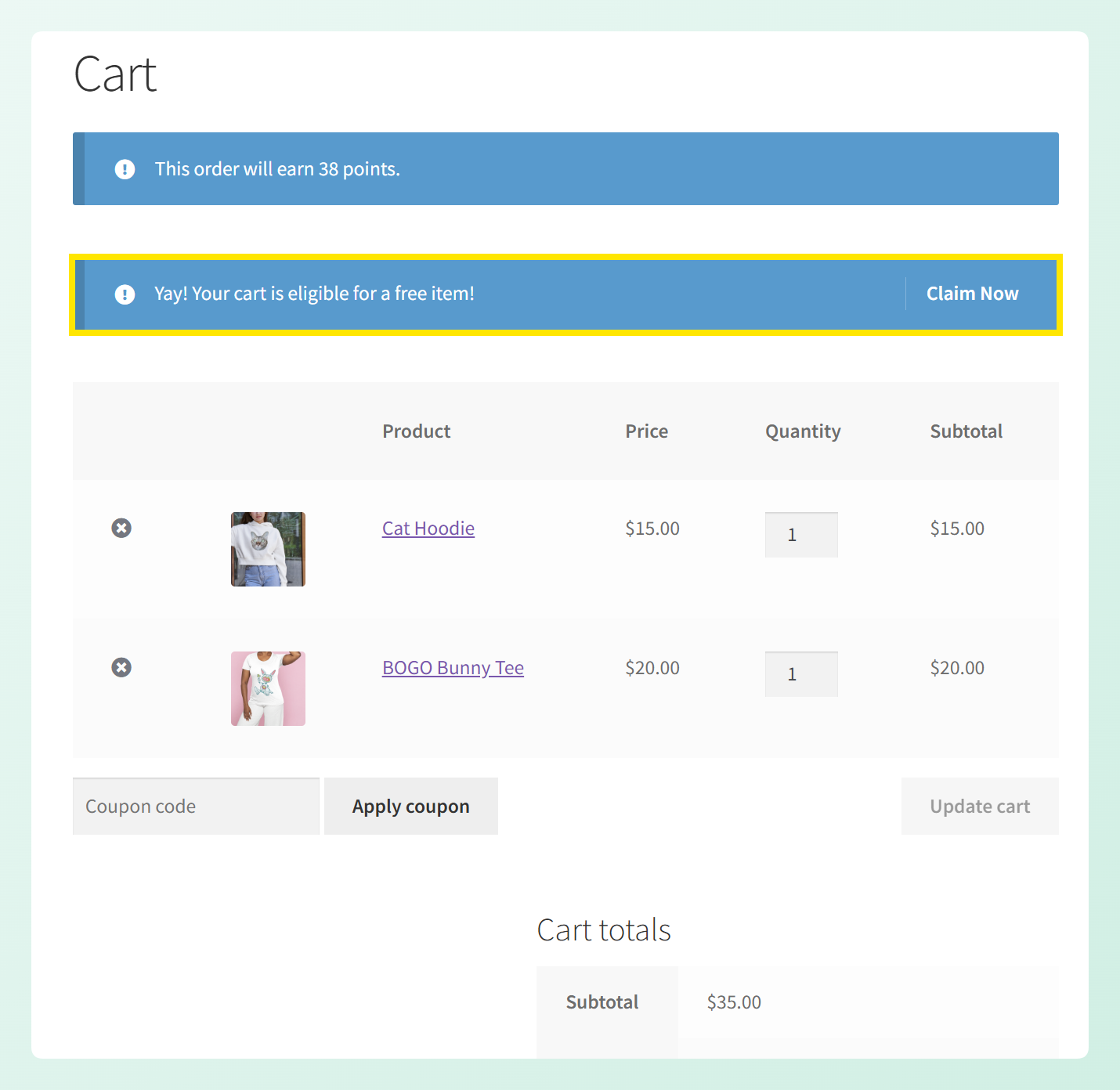
For our example, we’ve enabled One Click Apply and customized both the notification message and button text. Shoppers who qualify will see that they’re eligible for a free item, along with a Claim Now button.
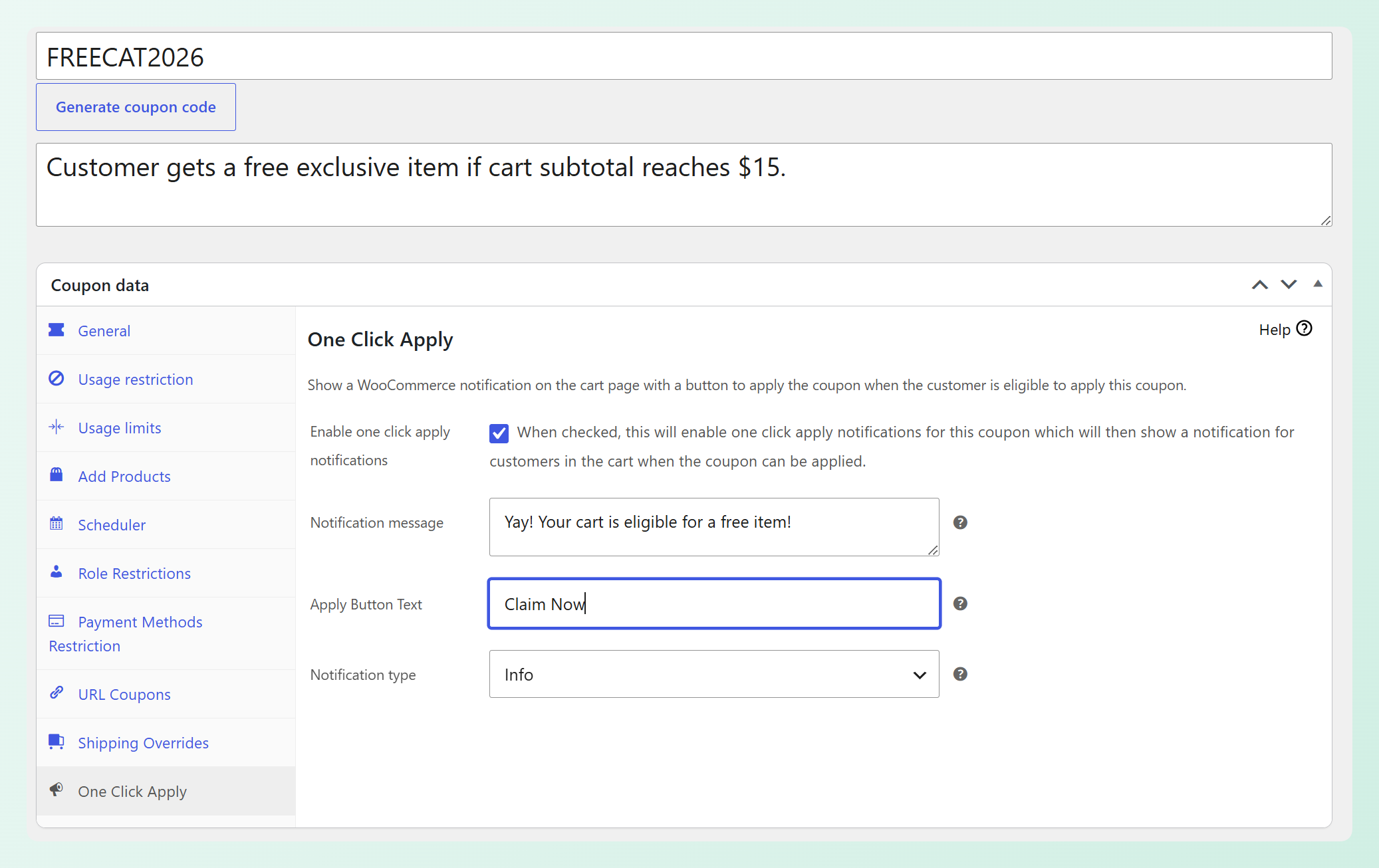
For a classic opt-in order bump, One Click Apply is the closer match. It works with both classic cart and checkout pages and the WooCommerce Cart and Checkout blocks. If you intentionally want the add-on inserted automatically instead, Auto Apply can handle that when the cart conditions match.
You may also see the setting add undiscounted products before coupon restrictions and cart conditions. It only affects Add Products rows set to No discount. Since a paid bump will usually use Override price, Fixed discount, or Percentage discount, you can normally leave this off.
Step 5: Test both a qualifying and a non-qualifying cart
If you are using One Click Apply, build a qualifying cart and confirm the notice appears, then click it and check that the product is added at the price you set. In our example, the cart subtotal is above $15, so the shopper sees the free-item notice and the Claim Now button.
After clicking Claim Now, the coupon is applied and the configured Cat Tote Bag is added to the cart at the override price we set.
Finally, build a non-qualifying cart and confirm the notice does not appear. If you are using Auto Apply instead, confirm the qualifying cart adds the product automatically and the non-qualifying cart does not.
What To Offer And How To Price It
Keep the bump price small relative to the shopper’s main purchase. It should feel like an easy add-on while still making sense for the product you’re offering.
Pick one bump per offer. Two competing add-ons at checkout create a comparison, and comparisons belong earlier in the journey.
If you use a minimum-spend condition, test carts on both sides of the threshold. A cart just above it should qualify, while one just below it should not. Testing both sides helps you catch condition mistakes before customers run into them.
Coupon usage can show how often the offer ends up on an order, but it does not measure how many shoppers saw the bump or clicked Claim Now. With Auto Apply, it also cannot tell you whether a shopper actively chose the add-on. Treat usage as a basic performance signal rather than a true order bump acceptance or conversion rate.
Frequently Asked Questions
What is an order bump in WooCommerce?
An order bump is a small optional add-on offered at checkout, after the shopper has chosen their main purchase but before payment. It is priced well below the cart value and designed to be accepted in one click without leaving the checkout page.
What is the difference between an order bump and an upsell?
An upsell asks the shopper to swap what they chose for a higher-tier version, so it revisits a decision they already made. An order bump leaves the original choice alone and simply adds a small related item, which usually asks for less deliberation.
Do I need a separate plugin for order bumps in WooCommerce?
Not necessarily. Advanced Coupons Premium can recreate the opt-in mechanic with Add Products, cart conditions, and One Click Apply on both classic cart and checkout pages and the WooCommerce Cart and Checkout blocks. There is no menu item called “order bump,” but the components are there. If you want purpose-built bump layouts and split testing, a dedicated funnel plugin is the better fit, and we use one on our own store.
What should I offer as an order bump?
Something small, obviously related, and requiring no choices. Consumables the main product uses, protection or care items, a travel size of what is already in the cart, gift wrapping, or a digital add-on with no fulfillment cost.
Can an order bump apply automatically?
You can add the coupon-based offer automatically with Auto Apply, but that is a different shopper experience from a classic opt-in order bump. When the cart conditions match, Auto Apply applies the coupon and the configured Add Products item is inserted automatically. Auto Apply is a Premium feature.
Start Adding Order Bumps To Your Checkout
A good order bump gives shoppers an easy way to add something useful before they pay, while giving you another opportunity to increase the value of the same checkout.
Here is where to start:
- What Is An Order Bump?: the timing and size that define it
- Order Bump Vs Upsell Vs Cross-Sell: pick the right mechanic
- Order Bump Examples That Work: choose something obvious
- How To Build A WooCommerce Order Bump: Add Products plus a cart condition
- What To Offer And How To Price It: keep it proportionate, and test both sides
If you already have Advanced Coupons Premium, you can build a WooCommerce order bump workflow with Add Products, cart conditions, and One Click Apply without adding another plugin to your stack.