

After you’ve invested time, effort, and money into launching a loyalty program, you want proof that it’s paying off. While sign-ups and points issued are encouraging, they don’t tell the full story. Tracking and analyzing specific loyalty program KPIs can help you understand whether your rewards strategy is truly driving repeat purchases, higher order values, and stronger customer relationships.
That’s what we’ll look into today! In this guide, we’ll walk you through the most essential loyalty program KPIs, what each one measures, why it matters, and how to interpret the results. Here’s a quick summary if you’re short on time:
| KPI | What it measures | Why it matters |
|---|---|---|
| Loyalty program enrollment rate | % of customers who join your loyalty program | Shows how appealing and visible your program is |
| Redemption rate | % of earned points that customers redeem | Indicates if members find your rewards valuable and usable |
| Repeat purchase rate | % of customers who place more than one order | Reveals how well you turn first-time buyers into repeat ones |
| Points earned by source | Which activities generate the most points | Confirms you’re rewarding behaviors that drive real growth |
| Top-earning customers | Customers who consistently earn the most points | Helps you identify and nurture your VIPs |
| Churn rates | How many customers become inactive over a period | Shows how effectively you retain customers over time |
What Are Loyalty Program KPIs?
Loyalty program KPIs (key performance indicators) are specific metrics you use to measure the effectiveness of your loyalty program. They help you understand whether your rewards system is attracting the right customers, keeping them engaged, and contributing to your overall revenue. These metrics can be:
- Short-term engagement KPIs: Help you understand how customers respond to your program in the early stages. For example: sign-up rate, first purchase after joining, points earned, and early redemptions.
- Long-term value KPIs: Reveal the ongoing impact of your program on the business. For example: repeat purchase rate, churn or retention, average order value (AOV), and the share of revenue coming from loyalty members.
Because these metrics are measurable and trackable over time, they give you valuable insights to guide your decision-making. You’re able to spot which rewards are working, where members drop off, and which customer segments deliver the most value. From there, you can optimize and refine your earning rules, rewards, and loyalty program promotion so your program stays relevant and profitable.
6 Essential Loyalty Program KPIs You Should Track
Now that we understand what loyalty program KPIs are, let’s look at the specific metrics that matter for your business. Tracking these consistently helps you see whether your loyalty program is actually profitable and aligned with your goals.
1. Loyalty program enrollment rate
The loyalty program enrollment rate measures how many of your customers are actually joining your rewards program. It’s an early indicator of how compelling and well-promoted your program is.
Here’s a simple way to calculate it:
Enrollment rate = (Number of loyalty members / Total number of customers) x 100
Depending on your setup and needs, you can look at this in two ways:
- Overall enrollment: Compare the total number of loyalty members to your total customer base. This tells you how widely adopted your program is.
- Enrollment over a time period: For example, new members this quarter ÷ total customers who purchased this quarter. This helps you see whether recent changes (like a new sign-up banner or welcome bonus) are working.
Depending on the industry, the average loyalty program enrollment rate ranges from 20% to 60%. As a general reference, many businesses aim for a significant portion of their customer base to be enrolled. The goal is to increase this percentage over time as you improve your offers and loyalty program promotion.
Here are some tips to help you increase your loyalty program enrollment rate:
- Keep sign-up as frictionless as possible. Use existing customer details where you can and avoid asking for unnecessary information up front.
- Highlight the benefits next to the join option. Be specific: “Join to earn points on every order and redeem them for discounts” instead of just “Join our rewards program.”
- Promote it in high-intent areas. Add loyalty prompts on product pages, in the cart, at checkout, and in account pages so customers see it naturally while shopping.
2. Redemption rate
Redemption rate measures the percentage of earned points that customers actually redeem. It’s one of the most important loyalty program KPIs because it reveals if shoppers are actually engaging and making the most of your program.
Most business owners use this simple formula to calculate their loyalty program redemption rate:
Redemption rate = (Total points redeemed / Total points issued) x 100
If you’re using a plugin like WooCommerce Loyalty Program, you can easily check how many points have been issued, redeemed, unused, and expired. This gives you a quick overview of how healthy your program is and whether points are actually turning into real discounts and orders.
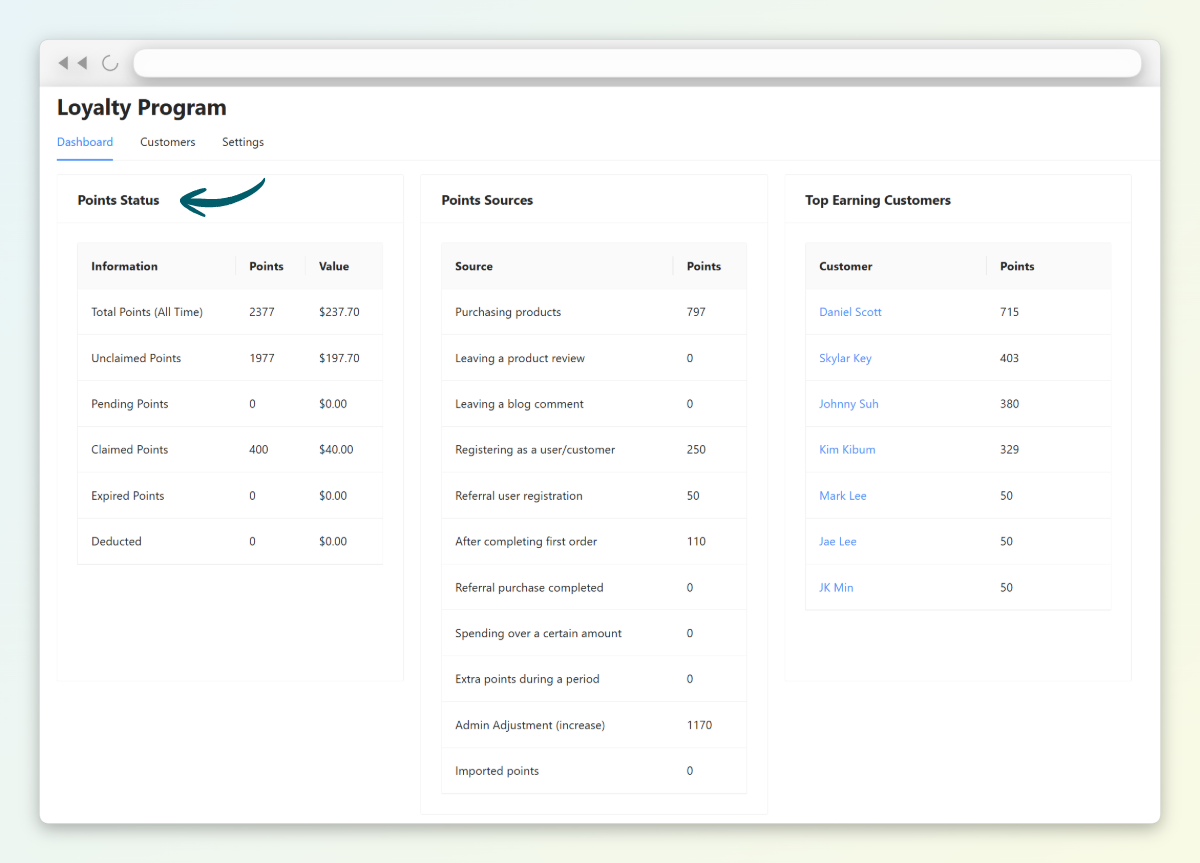
To improve redemption rates, it’s important to communicate the value of your rewards clearly and make points redemption as frictionless as possible. Let customers know what their points are worth in simple terms and remind them of their balance through email reminders and on-site prompts in high-intent areas like the cart, checkout, and account pages.
3. Repeat purchase rate
One of the main reasons why you launched a loyalty program is to encourage customers to return. This is why we can’t miss mentioning the repeat purchase rate on this list. This metric measures how many of your customers come back to place another order.
A simple way to measure it is through this formula:
Repeat purchase rate = (Number of repeat customers / Total number of customers) x 100
You can calculate this for your entire store, but you’ll get deeper insights when you compare the repeat purchase rate of loyalty members vs non-members over the same period. If loyalty members have a higher repeat purchase rate, it’s a strong indication that your program is effective.
🎯 POWER TIP: In WooCommerce, you can use your order data and customer lists to identify how many buyers have placed multiple orders, then use your loyalty data on top to see which of those are members. A loyalty plugin like WooCommerce Loyalty Program helps here by tying points to each purchase, so you can quickly see which customers are consistently ordering and earning points.
4. Points earned by source
Points earned by source help you identify the mix of activities that are generating the most points and whether your rewards program is rewarding the behaviors that actually grow your store.
Ideally, a points-earning mix should lean more toward revenue-generating actions, such as orders or referral purchases. If you’re using a tool like WooCommerce Loyalty Program, you can easily set which actions get rewarded and gain complete visibility on how many points are earned from each activity through the Points Sources section in your dashboard.
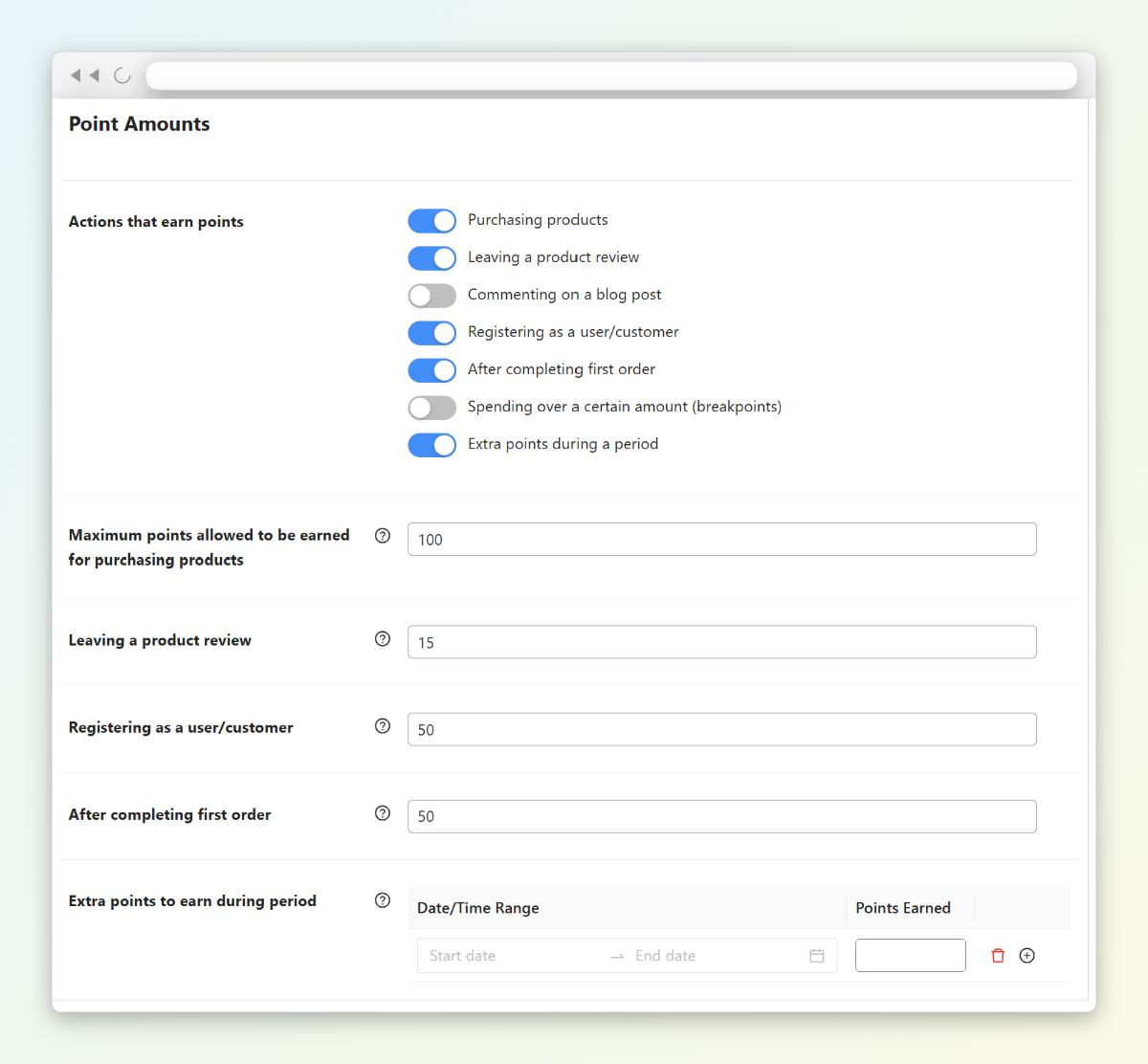
If you notice that a large share of points is coming from low-value actions (or frequent admin adjustments), you might want to modify your earning rules. For instance, you can:
- Balance your mix: Review your current earning rules and adjust them so that most points are earned through purchases, higher order values, or completed referrals.
- Promote high-value actions: Highlight key earning opportunities—such as “earn more points when you spend over $X” or “get bonus points for your first purchase”—on product pages, the cart, and post-purchase emails.
- Reduce low-impact sources: Lower or remove points for actions that don’t lead to meaningful engagement or revenue, so your program doesn’t over-reward behaviors that don’t move the needle.
RELATED READ: How To Structure An Effective Reward Points System

5. Top-earning customers
This metric helps you identify the “VIPs” in your customer base. They’re the shoppers who consistently earn points in your program—usually because they order often, spend more than regular customers, and engage in multiple points-earning activities (like reviews and referrals).
It matters to know who your best customers are, because it allows you to:
- Understand which types of customers respond best to your rewards
- Spot patterns in their behavior (order frequency, basket size, preferred categories)
- Design perks, tiers, or campaigns specifically for them
Your most engaged customers are also your most valuable growth drivers. According to a McKinsey report, loyal customers are 64% more likely to purchase frequently and 31% more willing to pay a higher price to stay with a brand.
By knowing exactly who your top customers are, you can take steps to keep them engaged with your store. For example, you might offer early access to new collections, exclusive point multipliers, or surprise-and-delight bonuses for your highest-value customers.
💡 GOOD TO KNOW: WooCommerce Loyalty Program makes this easy by showing a Top Earning Customers list in your dashboard. You can quickly see which customers have the highest point balances and how many points they’ve earned.
6. Churn rate
Churn rate measures how many customers stop doing business with your store over a certain period of time. One of the core goals of a loyalty program is to slow this drop-off by giving shoppers reasons to stay, return, and keep engaging with your brand.
It’s calculated using this simple formula:
Churn rate = (Number of customers who became inactive during a period / Total active customers at the start of the period) x 100
Churn rate is one of the most essential loyalty program KPIs because it shows how effectively you’re retaining the customers you’ve already worked hard to acquire. A lower churn rate indicates that customers see value in doing business with you—through your products, experiences, and rewards.
Reducing churn is also more cost-effective than constantly acquiring new customers, which can cost up to seven times more. The goal is for customers to leave less often and remain active for longer.
Here are some helpful tips to reduce churn rates:
- Reward comeback behavior: Offer small bonuses for “win-back” orders (e.g., extra points when they place their next purchase after a period of inactivity).
- Make loyalty rewards feel achievable: If customers feel they’ll never reach a reward, they’ll lose interest faster. Review your earning and redemption thresholds to make sure they feel fair and attainable.
- Set up re-engagement prompts: Send reminder emails or offers when a member hasn’t purchased in a while, especially if they have unused points close to a reward.
RELATED READ: Customer Winback Strategy: 6 Proven Strategies That Work
Frequently Asked Questions
How to measure loyalty program success?
To measure loyalty program success, use KPIs (key performance indicators) like loyalty program enrollment rate, repeat purchase rate, churn rate, and redemption rate. If you notice more customers joining, coming back to buy again, redeeming rewards, and staying active for longer, those are strong signs your program is working.
What is loyalty KPI management?
Loyalty program KPI management is the process of selecting, tracking, and analyzing key metrics that define loyalty program performance. This can include metrics like points redemption rates, churn rates, repeat purchases, and more. Regularly tracking and interpreting these metrics gives you insight into customer behavior, which helps you adjust earning rules, rewards, and loyalty program campaigns for better performance.
How can I improve my loyalty program KPIs over time?
Review your current numbers and implement changes to improve them. For instance, if you discover that redemption rates are low, you can take steps like simplifying your messaging, adjusting earning and redemption thresholds, and sending timely reminders to members who are close to a reward or haven’t purchased in a while. Repeat this process in cycles: check your loyalty program KPIs, make one or two changes, give them time to run, then review the impact and refine again. Over time, this steady test–measure–improve loop will help you build a better loyalty program.
Wrapping Up
Tracking the right loyalty program KPIs helps you understand if your rewards system is really moving the needle for your business. In this helpful guide, we walked you through the most important loyalty program metrics you need to know, including:
- Loyalty program enrollment rate
- Redemption rate
- Repeat purchase rate
- Points earned by source (earning activities mix)
- Top-earning customers
- Churn rate
If you’re running a WooCommerce store, WooCommerce Loyalty Program plugin gives you a structured way to put all of this into practice—letting you award points, track member activity, and gain the insights you need to keep improving your rewards system.
We hope this article helped! ☺️