

“Is my loyalty program making money?” Most WooCommerce store owners running a points program do not have a clear answer. They may know their redemption rate, active member count, and even their total discount liability. But it is much harder to tell whether the program is actually bringing in more revenue than it costs.
Loyalty programs can absolutely create real value, but industry averages will not tell you whether your own program is working. A better question is whether your loyalty members are buying more often, spending more over time, and generating enough incremental revenue to justify the rewards you are giving away.
This guide walks you through a practical WooCommerce loyalty program ROI formula, a worked example, and the leading indicators that can help you tell whether your program is moving in the right direction before ROI is fully measurable.
The Two Sides Of WooCommerce Loyalty Program ROI
A loyalty program has costs and returns. The math is straightforward in principle and slippery in practice, because the revenue side requires comparing members to non-members — and separating the program’s actual influence from the fact that more engaged customers tend to join loyalty programs in the first place.
Cost side (what you can measure exactly):
- Plugin or tool cost
- Redeemed discount value (points actually exchanged for discounts)
- Outstanding points liability (points earned but not yet redeemed)
- Staff time to manage the program
Revenue side (what you estimate, not measure exactly):
- Incremental repeat purchase revenue attributable to the program — the revenue that wouldn’t have happened without the loyalty program
The gap between cost and revenue is your ROI. Let’s calculate each side.
Step 1: Calculate Your Loyalty Program Costs
Plugin cost
The Advanced Loyalty Program is available as a standalone plugin or as part of the All Access Bundle. For this worked example, we’ll use the All Access Bundle cost of $249/year.
Redeemed discount value
Every redeemed point creates a real discount cost. If 10,000 points are redeemed at 100 points = $1, the redeemed value is $100. Our loyalty points calculator does this points-to-dollars math for you. To estimate this for your store, total the order-level discount or store-credit value tied to loyalty redemptions over the period you’re measuring. In this worked example, that comes to $2,400/year.
Outstanding points liability
Points earned but not yet redeemed are a future cost. Calculate: total outstanding points × redemption value per point. If 50,000 points are outstanding at $0.01 per point, your liability is $500. Not an immediate cash cost, but it belongs in your ROI thinking — it will eventually be redeemed or written off when points expire.
Time cost
Estimate hours per month managing the program and multiply by your hourly cost. For most stores: 2–4 hours/month. In the worked example: $600/yr (2 hrs/month at $25/hr).
Total annual program cost for the worked example:
- Plugin: $249
- Redeemed discounts: $2,400
- Time: $600
- Total: $3,249/yr
Step 2: Calculate Revenue Attributable To The Program
This is the harder side. The question is: how much additional revenue do loyalty program members generate that they wouldn’t have generated without the program?
The clean way to answer it: compare loyalty member purchase frequency and annual spend against a matched control group of non-members with similar RFM profiles (recency, frequency, monetary value). Most stores don’t have a formal control group.
Practical proxy approach:
- Pull the average annual spend for loyalty program members from WooCommerce order data, filtered by customer email
- Pull the average annual spend for non-members
- The difference is your estimated incremental spend per member
Caveat: Members self-select into loyalty programs. Higher-value customers are more likely to join, which means some of the spend difference existed before the program. This method overstates the program’s contribution. The worked example below acknowledges this and shows both a ceiling and a conservative estimate.
Step 3: The ROI Formula (With A Worked Example)
The formula:
ROI = (Incremental revenue from members − Program costs) ÷ Program costs × 100
Based on a typical mid-size WooCommerce store, here’s how this might look (example data):
Worked example — a WooCommerce store with 500 active loyalty members:
| Metric | Members | Non-members |
|---|---|---|
| Avg annual spend | $180 | $110 |
| Incremental per member | $70 | — |
| Active members | 500 | — |
| Total incremental revenue | $35,000 | — |
Program costs: $3,249/yr
Ceiling ROI (assuming all spend difference is program-driven):
($35,000 − $3,249) ÷ $3,249 × 100 = 977%
That number is the ceiling. The self-selection problem means some of those members were already $180/yr customers before joining. A conservative assumption — 50% of the spend difference is pre-existing behavior, 50% is program-driven:
Conservative ROI (50% attribution):
($17,500 − $3,249) ÷ $3,249 × 100 = 439%
At 25% attribution (only 1 in 4 dollars of the gap is program-driven):
Conservative ROI (25% attribution):
($8,750 − $3,249) ÷ $3,249 × 100 = 169%
The worked example illustrates two things: loyalty programs can generate strong ROI even with conservative attribution assumptions, and the range of outcomes is wide depending on how much of the member spend lift is genuinely program-driven.
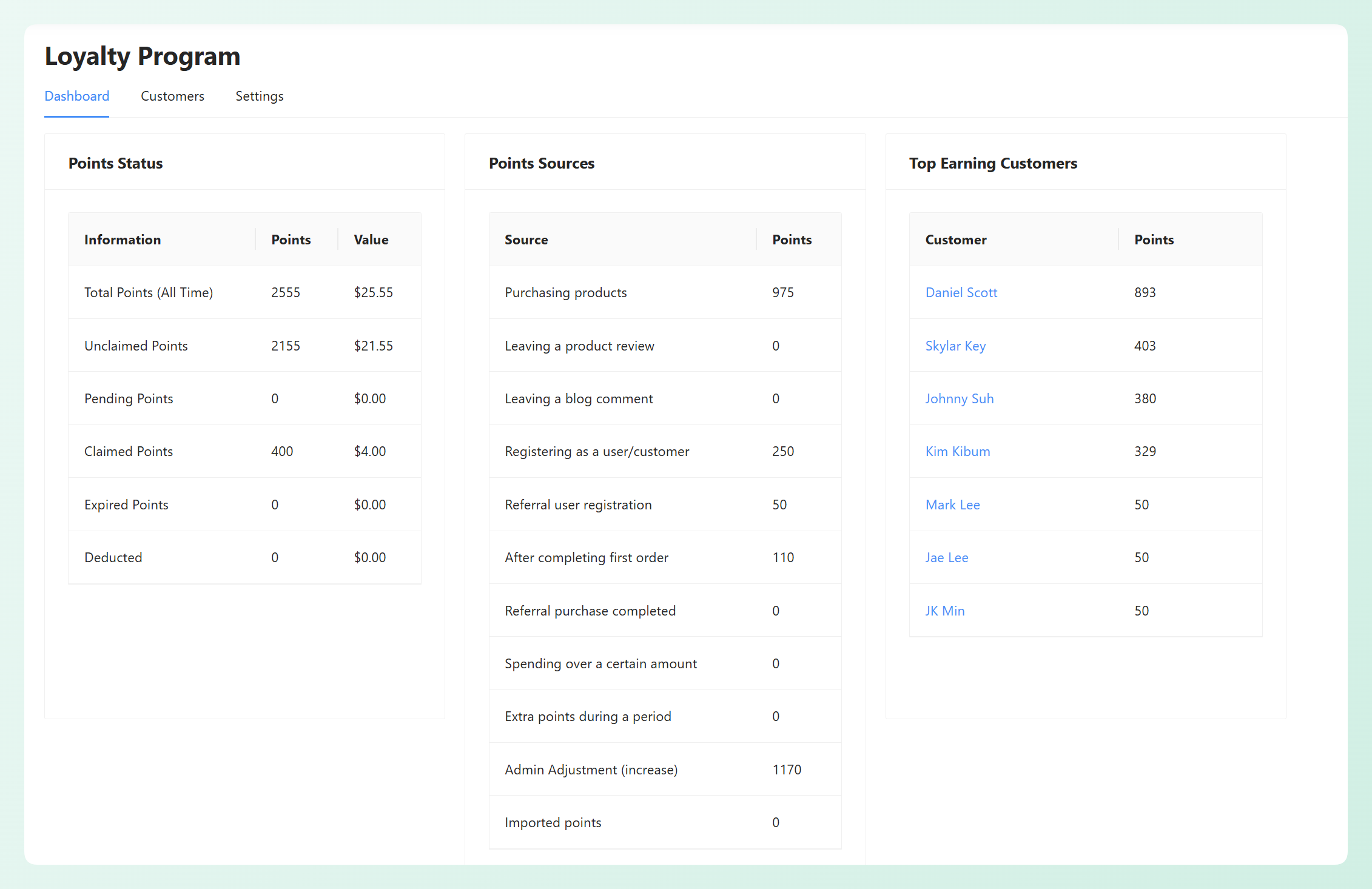
In Advanced Loyalty Program, the dashboard gives you a useful view of member and points activity. For a full ROI calculation, though, you’ll still need WooCommerce order data to compare member and non-member spending and estimate the dollar impact of loyalty redemptions.
What A Healthy ROI Looks Like (And The Payback Timeline)
Most loyalty programs do not show a clean positive ROI in the first few months. That doesn’t automatically mean the program is failing. The cost side shows up first, while repeat-purchase behavior takes time to build.
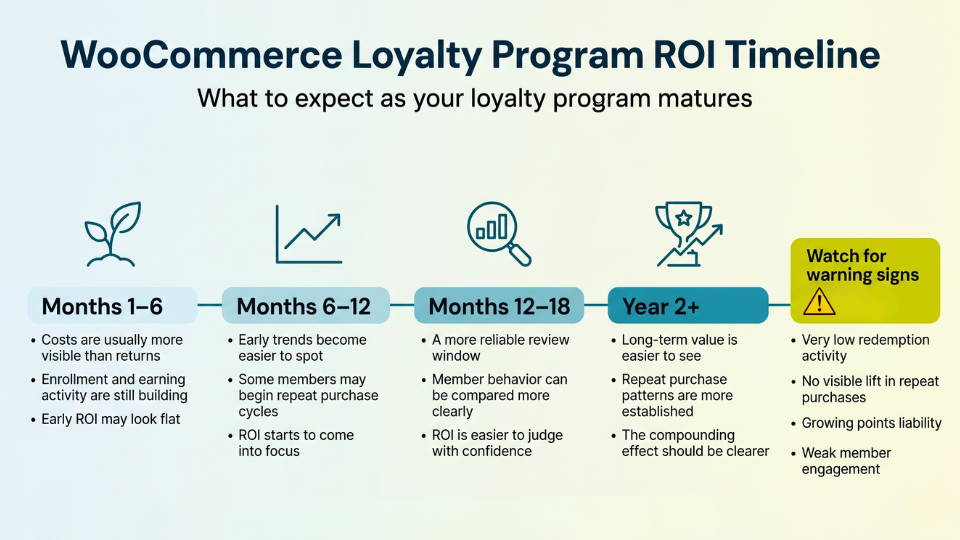
Typical payback pattern for stores with real repeat-purchase potential:
- Months 1–6: It’s common for costs to outweigh returns. You’re still building enrollment, earning activity, and the first wave of redemptions.
- Months 6–12: This is often the first real review window. Early cohorts may begin their second or third purchase cycle, and the ROI picture starts to get clearer.
- Months 12–18: For many stores, this is when ROI becomes much easier to judge with confidence. You have enough repeat-purchase history to compare member behavior against your baseline.
- Year 2+: If the program is well structured, the compounding effect should be much easier to see in member retention, repeat purchase frequency, and overall customer value.
A good rule of thumb: judge the program less by one “perfect” ROI number early on, and more by whether the economics are moving in the right direction over time. The more often your customers naturally repurchase, the sooner that becomes visible.
The Metrics That Signal The Program Is Working Before ROI Is Measurable
If you’re still in the first year and your WooCommerce loyalty program ROI is too early to measure cleanly, these metrics can tell you whether the program is moving in the right direction:
Enrollment rate: Is your active member base growing month over month? If not, the program may not be compelling or visible enough to matter later.
Redemption rate: This is one of the clearest early signs of engagement. As a practical benchmark, a redemption rate above 10% usually suggests members are finding the rewards meaningful. If it stays below 5% for too long — especially with decent enrollment — the issue is often the setup: the earning rate, redemption threshold, or reward appeal.
Member vs. non-member repeat purchase rate: This is often a better signal than revenue alone early on. If loyalty members are beginning to repurchase more often than your broader customer base, that’s a strong sign the program is influencing behavior.
Points liability as a percentage of revenue: Outstanding points are a future discount obligation. As a rough guardrail, many stores will want this to stay in the low single digits relative to revenue — around 3% to 5% can be a useful starting benchmark. If liability keeps climbing while member behavior stays flat, the economics may be drifting in the wrong direction.
For the full operational KPI framework, see our loyalty program KPIs guide.
When To Rethink The Program
A loyalty program usually shouldn’t be judged too early, but it also shouldn’t run indefinitely without signs of traction.
A practical review point is somewhere around the 12–18 month mark, especially for stores with a normal repeat-purchase cycle. By then, you should have enough data to judge whether the program is changing customer behavior in a measurable way.
Warning signs include:
- Redemption rate stays extremely low — for example, hovering below 3% even after the program has had time to mature
- Member repeat purchase behavior still looks almost identical to your non-member baseline
- Points liability keeps growing faster than the value the program appears to be creating
- Enrollment is happening, but members are not earning and redeeming in meaningful ways
That doesn’t always mean the idea of loyalty is wrong for your store. It may simply mean the structure needs work — point values, redemption thresholds, expiry settings, promotion, or reward design.
A common mistake is evaluating the program too early. The first few months usually show the cost of the program more clearly than the return, especially while enrollment, earning activity, and repeat-purchase behavior are still building. If your leading indicators are moving in the right direction, an early flat ROI number does not automatically mean the program is failing.
If the decision is genuinely to stop, coupon-based alternatives give faster, measurable returns. See our guide on increasing customer lifetime value for a broader framework.
Frequently Asked Questions
How long before a loyalty program is profitable?
There isn’t one universal timeline for loyalty program profitability. Stores with frequent repeat purchases may see meaningful results sooner, while stores with longer buying cycles usually need more time before ROI becomes clear. What matters most is whether member behavior is improving in a way your margins can support.
What’s the biggest hidden cost in a loyalty program?
Outstanding points liability — points earned but not yet redeemed. This grows quietly as more customers join and earn points. Without expiry, it becomes a large discount obligation sitting on your books. Set a rolling 12-month expiry and a reachable redemption threshold to keep liability in proportion to revenue.
How do I know if my loyalty members would have been repeat buyers anyway?
You can’t know for certain without a control group. The best proxy: compare member repeat purchase rate to your store’s non-member baseline, and look at whether members who joined during a neutral period (not a promotional push) show different behavior than non-members over the following 12 months. If members joined because of a launch promotion, self-selection bias is built in — discount that group’s contribution estimate accordingly.
Is loyalty program ROI better for high-AOV or low-AOV stores?
High-AOV stores often have more upside per repeat purchase, because each additional order is worth more. Low-AOV stores can still generate strong loyalty program ROI if customers buy often enough for the rewards to influence behavior. The harder cases are stores with both thin margins and infrequent purchases — in those situations, a points program may need a very careful structure to stay profitable.
Wrapping Up
A loyalty program can become a strong long-term growth driver for a WooCommerce store, but it usually needs time before the full return becomes clear. What matters most is not just the final ROI number, but whether member behavior is moving in the right direction as the program matures.
A practical way to measure that is to compare the incremental revenue from loyalty members against the real cost of running the program, then use conservative attribution so your estimate stays grounded. That gives you a more useful picture than relying on a best-case number alone.
If enrollment is growing, rewards are being redeemed, and loyal customers are starting to buy more often, the program is likely building momentum even before the ROI is fully visible. And if you want a simpler way to manage that experience inside WooCommerce, Advanced Loyalty Program gives you the tools to launch, track, and grow a loyalty program that’s built for repeat purchases.