

An ecommerce rewards program can look simple from the outside: shoppers earn points, redeem rewards, and come back to buy again. But if you launch without a financial plan, it can be hard to tell whether those rewards are increasing repeat purchases or simply discounting orders that would have happened anyway.
That’s why it helps to map out the business side before you turn the program on. You need a clear point value, a realistic redemption threshold, launch milestones, and a simple way to compare reward costs against repeat-purchase revenue.
This guide gives you a practical framework for planning an ecommerce rewards program in WooCommerce. You’ll get a break-even calculation, a point value strategy, a 90-day launch plan, and the KPIs that help you understand whether your program is moving in the right direction.
The Business Case For A WooCommerce Rewards Program
A rewards program can help increase repeat purchase rate and customer lifetime value. But by how much, and at what cost? The answer depends on your store’s margins and how well you design the program.
The data supporting loyalty programs is strong. According to Bain & Company, a 5% increase in customer retention can increase profits by 25% to 95%, depending on industry. That range is wide, but the direction is consistent: keeping existing customers buying is significantly more profitable than acquiring new ones.
On the revenue side, Accenture research (2016) found that loyalty program members generated 12% to 18% more revenue for retailers than non-members. More recently, a Capital One Shopping report noted that most consumers belong to at least one customer loyalty program, which shows how familiar rewards programs have become to shoppers.
Those are industry-wide averages. Whether your WooCommerce store sees those results depends on three things: your margins, your purchase frequency, and how well you structure the program. The rest of this article helps you figure that out. For a deeper look at the underlying revenue mechanics, read about the loyalty program business model.
Calculating Your Rewards Program Break-Even Point
The break-even point is where the revenue your rewards program generates exceeds what it costs you in margin. Getting this number right before you launch is one of the most important planning steps.
Here’s the formula:
- Program cost: the discount value of redeemed points, expected point liability, plugin/license costs, and any launch promotion costs you choose to track
- Program revenue: your best estimate of incremental repeat-purchase revenue from loyalty members compared with your pre-program baseline or non-member customers
- Break-even: the point where incremental gross margin from the program exceeds the costs of running it
Worked example
Here’s what this looks like in practice (example data):
Imagine a store with $50 average order value, 30% margin, and 1,000 monthly orders. The points earning ratio is 1 point per $1 spent, and the redemption ratio is 100 points for a $1 discount. That’s a 1% effective reward rate.
- Potential reward value issued: $500 (1,000 orders x $50 x 1%)
- If the program lifts repeat purchases by 5%: that’s 50 additional orders. At $50 each, that’s $2,500 in additional revenue and $750 in additional gross margin.
- Result: in this simplified example, the additional gross margin is higher than the potential reward value issued before factoring in plugin costs or other launch expenses.
Now compare that with a smaller lift. If repeat purchases increase by 2%, that’s 20 additional orders, $1,000 in revenue, and $300 in gross margin. In that case, the program may still be valuable, but the margin impact is tighter and depends on how many points customers actually redeem, how quickly they redeem them, and whether those redemptions lead to additional purchases.
The break-even point depends on three variables: your margin, the effective reward rate, and the repeat purchase lift. The goal is not to predict the exact month perfectly. It’s to understand how much lift your ecommerce rewards program needs before the reward cost starts putting pressure on your margins.
Break-even quick reference (example data)
- 1% effective reward rate (100 points = $1): needs roughly a 3% repeat purchase lift to break even at 30% margin
- 2% effective reward rate (50 points = $1): needs roughly a 7% lift
- 3% effective reward rate (33 points = $1): needs roughly a 10% lift
- 5% effective reward rate (20 points = $1): needs roughly a 17% lift, which is risky for most small WooCommerce stores
🎯 Tip: A lower effective reward rate gives you more room to test your ecommerce rewards program without putting too much pressure on your margins. Starting with a conservative rate, then adjusting after you review redemption behavior, repeat purchases, and margin impact, is usually safer than launching with a generous reward rate you may need to pull back later.
Setting Point Values And Reward Tiers That Make Financial Sense
Your point structure determines how much margin the program costs and how customers perceive its value. The goal is a structure that feels generous without eating into profit.
Choosing an earning ratio
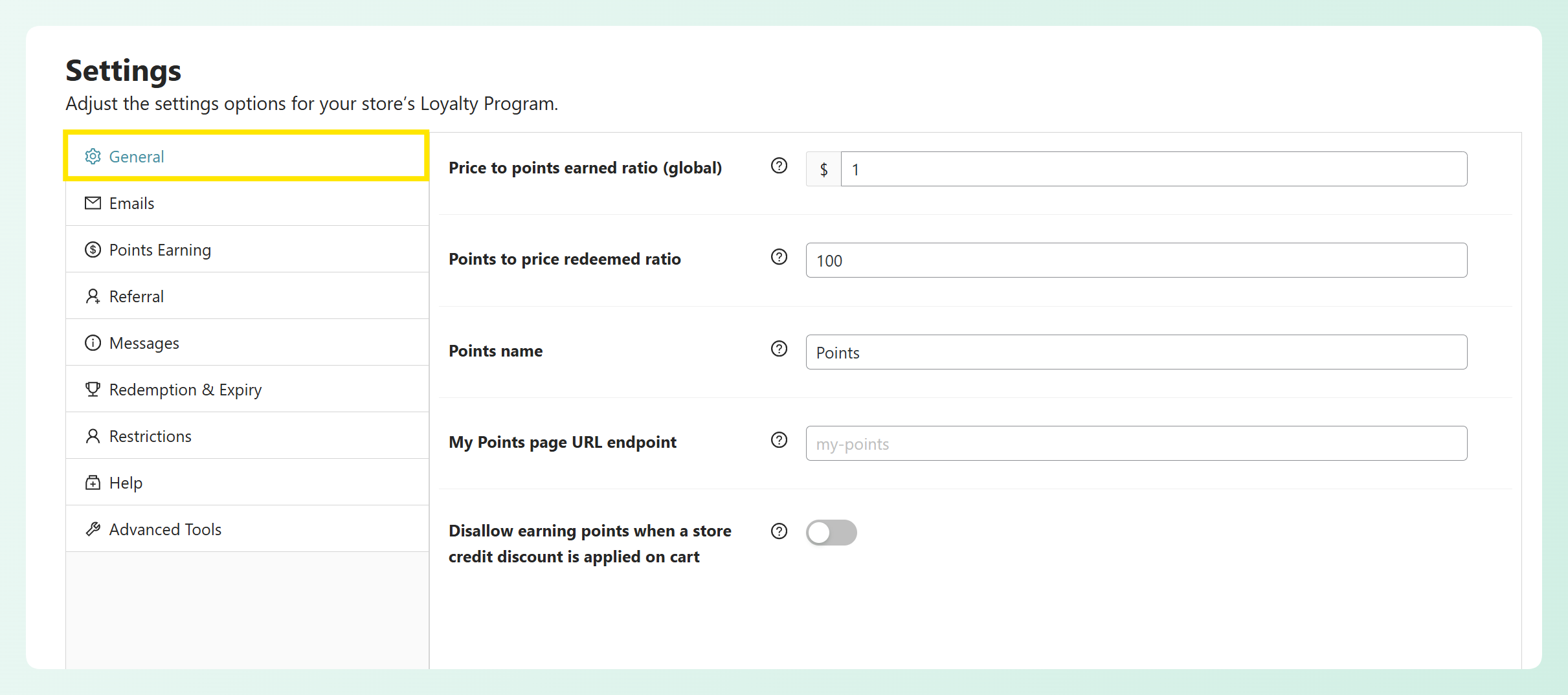
Common options include 1 point per $1, 2 points per $1, or 10 points per $1. The earning ratio is psychological, not financial. A customer who earns “50 points on a $50 purchase” and a customer who earns “500 points on a $50 purchase” are getting the same value. The only number that matters financially is the redemption ratio, which determines how much each point is worth when redeemed.
Start simple. Set 1 point per $1 spent with 100 points equaling a $1 discount. That’s a 1% effective rate. It’s easy for customers to understand and it keeps your margin cost low. The Advanced Loyalty Program lets you configure both earning and redemption ratios directly in your WooCommerce dashboard.
Choosing a redemption threshold
The minimum points required to redeem should align with your typical repeat purchase window. If your average customer buys every 60 days and spends $50 per order, they earn 50 points per purchase. Setting the threshold at 100 points means they can redeem on their third order after two earning purchases.
This is intentional. It rewards repeat behavior, not one-time purchases. The customer needs to come back at least twice before they can redeem a discount, which helps align the reward with the repeat-purchase behavior you want to encourage.
When to add tiers (and when not to)
Tiers add complexity. Only add them if you have clear high-value customer segments with meaningfully different purchase frequencies.
For most WooCommerce stores launching their first program, skip tiers entirely. Start with a flat points structure. Add tiers later if the data shows a distinct VIP segment that warrants different treatment. Adding tiers too early creates confusion for customers and administrative overhead for you without enough data to justify the segmentation.
Promoting Your Loyalty Program Launch With Coupons
A strong loyalty program can still underperform if customers do not know it exists. You may activate the program, but if shoppers never see the points they can earn or understand how rewards work, the program can quietly run in the background without driving much engagement. It also helps to stack rewards with coupons and gift cards, so your launch gives shoppers more than one reason to join.
Here are practical launch tactics to make your program more visible:
- Launch with bonus points: Run a short bonus-points promotion during your launch window to give customers a reason to engage with the program early.
- Dedicated email announcement: Send a standalone email to your existing customer list announcing the program and linking customers to where they can view their points. Don’t bury this inside a general newsletter.
- Product, cart, and checkout messaging: Show customers how many points they can earn while they browse, review their cart, and complete checkout. This makes the reward feel more visible at the moment they’re deciding whether to buy.
- Product labels, if you use Advanced Promo Kit: Add labels such as “Earn Loyalty Points” or “Bonus Points This Week” to make the launch more visible while customers browse your store.
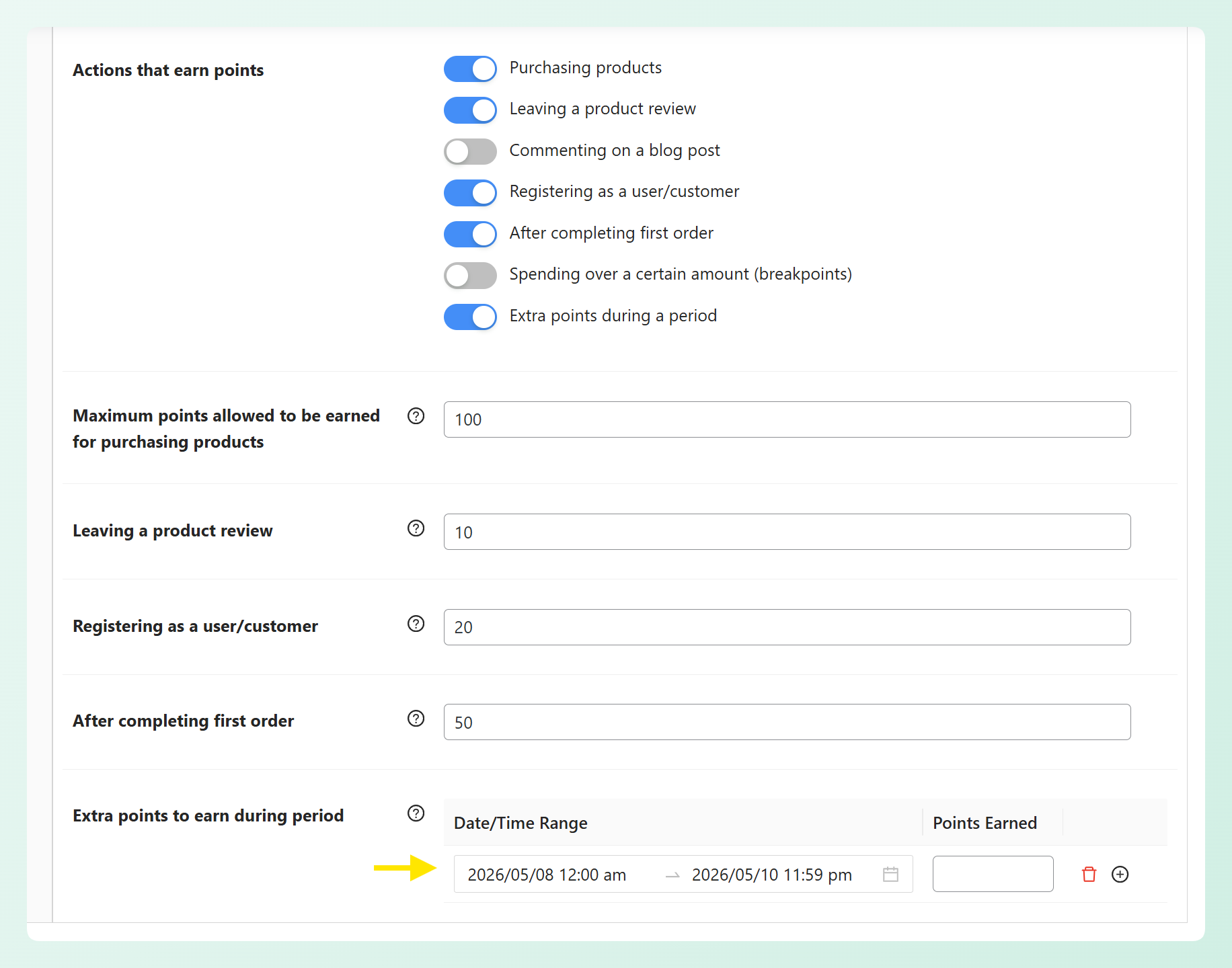
The key is to make the program visible where purchase decisions happen. An email introduces the ecommerce rewards program, but product-page, cart, and checkout messaging remind shoppers about the points they can earn while they’re actively considering a purchase. If you also use Advanced Promo Kit, product labels can help make loyalty-related promotions more visible while customers browse.
RELATED READ: How To Promote Loyalty Program (7 Effective Strategies)
The 90-Day Launch Timeline With Milestones
A structured timeline keeps you from guessing whether your program is working. Here’s a 90-day framework with practical checkpoints for each stage.
Days 1 through 30: launch and awareness
The first month is about getting the program in front of customers and starting to build point balances.
- Activate the program with a scheduled bonus-points promotion
- Send the launch email to your customer list
- Add loyalty-related product labels to featured products if you use Advanced Promo Kit
- Track enrollment rate (percentage of customers who have earned points) and points earning velocity
Day 30 milestone: check whether eligible customers are earning points and whether your launch messages are being seen. If very few customers have earned points, treat it as an awareness issue first. Revisit your product-page messaging, checkout messaging, email announcement, and product labels before changing the point structure.
Days 31 through 60: first redemptions
In the second month, some customers may start getting closer to the redemption threshold, depending on your purchase frequency, point value, and minimum redemption settings.
- Monitor redemption rate (percentage of earned points that get redeemed)
- Compare repeat purchase rate of loyalty members against your pre-program baseline
- Watch whether redemption is triggering incremental purchases or just discounting orders that would have happened anyway
Day 60 milestone: review whether customers are getting close to redemption and whether any early redemptions have happened. If balances are growing but customers are not redeeming, your threshold may be too high for your store’s purchase frequency. Track your loyalty program KPIs to spot these patterns early.
Days 61 through 90: measure and adjust
By day 61 you have enough data to evaluate whether the program is financially sound.
- Calculate your actual margin cost of redeemed points
- Calculate the actual repeat purchase lift (loyalty members versus non-members)
- Project your break-even date using the real data against the formula from the calculation section above
- Compare loyalty-member average order value against non-member average order value
Day 90 milestone: compare your actual reward costs, redemption activity, and repeat-purchase behavior against the model you built before launch. If the program is not moving toward break-even, review the basics first: reward rate, redemption threshold, program visibility, and whether loyalty members are actually purchasing more often than non-members.
Measuring Success With The KPIs That Matter
The right KPIs tell you whether your rewards program is generating profit or just creating the illusion of engagement. Focus on these first.
Primary KPIs:
- Repeat purchase rate (members versus non-members): This is one of the most important metrics to watch. If members are not buying more frequently than non-members, your program structure, visibility, or reward value may need adjustment.
- Revenue from loyalty activity: Track revenue from orders that included point redemption or loyalty member activity. This is a useful signal, but it should be compared against your baseline rather than treated as perfect attribution.
- Effective reward rate: Total points redeemed in dollar value divided by total revenue from loyalty members. This helps you estimate the actual reward cost of the program.
- Estimated program ROI: Compare incremental revenue from loyalty members against point redemption costs, plugin costs, and any launch promotion costs you choose to track.
Secondary KPIs:
- Enrollment rate: Percentage of customers who have earned at least one point
- Points earning velocity: How quickly balances grow, which predicts when redemption waves will hit
- Average points balance: If balances are high and climbing, customers aren’t redeeming, which likely means your threshold is too high or the value proposition is unclear
- Time to first redemption: How long it takes a new member to redeem their first points
Advanced Loyalty Program gives customers a clear way to view their points, redeem rewards, and review their points history from the My Account area. For a complete walkthrough of which metrics to track and when, read our guide on loyalty program KPIs. You should also understand how loyalty programs make money in WooCommerce to connect these KPIs back to actual revenue impact.
Frequently Asked Questions
How much does a WooCommerce loyalty program cost in margin?
The margin cost depends entirely on your effective reward rate. At a 1% effective reward rate (100 points = $1 discount), a store doing $50,000 in monthly revenue gives away roughly $500 per month in point redemptions. At 3%, that’s $1,500. The key is modeling this against your expected repeat purchase lift before launching, so the incremental revenue covers the cost.
What is a good effective reward rate for a small WooCommerce store?
Start between 1% and 2%. This keeps your margin cost low enough that even a modest lift in repeat purchases covers the program’s cost. You can always increase the rate later once you have 60 to 90 days of data showing the program’s actual impact on repeat purchase behavior.
How long does it take for a loyalty program to pay for itself?
It depends on your margins, reward rate, purchase frequency, and how quickly customers start redeeming points. A 60- to 90-day review window is useful because it gives you enough early data to compare reward costs, redemption activity, and repeat-purchase behavior. Stores with shorter repeat-purchase cycles may see useful signals sooner, while stores with longer buying cycles may need more time.
Should I start with points or cashback?
Points give you more flexibility. You can run bonus-points promotions, set redemption thresholds that encourage specific behaviors, and adjust the value over time. Cashback is simpler for the customer to understand, but it’s harder to create promotional events around. For most WooCommerce stores, points are the better starting point because they give you more levers to pull as you optimize the program.
Do I need a tiered program at launch?
No. Start with a flat points structure and collect data for 90 days. Add tiers only after you’ve identified a distinct VIP segment through the data. Launching with tiers adds complexity that distracts from the core question of whether the program is generating positive ROI.
Launch Your Ecommerce Rewards Program With Confidence
A rewards program is a financial decision. The framework in this article gives you the tools to make that decision with real numbers instead of guesswork. You know how to calculate break-even, how to set point values that protect your margins, and what milestones to hit at 30, 60, and 90 days.
Here’s what to do next:
- Calculate your break-even point using your store’s actual margin, order volume, and a 1% effective reward rate
- Set point values that make financial sense, starting with 1 point per $1 and 100 points for a $1 discount
- Promote the launch with a bonus-points promotion, a dedicated email, and clear product, cart, and checkout messaging
- Track the timeline with specific enrollment, redemption, and ROI milestones at day 30, 60, and 90
- Measure the right KPIs to know whether the program is generating profit or just activity
Ready to build a rewards program with a clearer plan behind it? Check out Advanced Loyalty Program pricing and get your program live today. For the step-by-step setup walkthrough, see our guide on how to start a loyalty program. If you’re still comparing tools, see our roundup of the best WooCommerce loyalty program plugins.