
WooCommerce loyalty points give your customers a reason to come back. Instead of chasing new traffic for every sale, a points-based rewards program turns one-time buyers into repeat customers who earn credit with every purchase, review, and referral.
The problem is that WooCommerce doesn’t include any loyalty or rewards features out of the box. There’s no native way to award points, track balances, or let customers redeem rewards at checkout. Without a dedicated plugin, you’re left building workarounds that don’t scale.
In this guide, you’ll learn how to set up WooCommerce loyalty points using the Advanced Loyalty Program plugin. We’ll walk through the full configuration in six steps, from setting your earn ratios to customizing the checkout experience.
Why WooCommerce Loyalty Points Matter For Your Store
A loyalty points program directly addresses the biggest expense in ecommerce: customer acquisition. Bringing in a new customer costs significantly more than getting an existing one to buy again. Points programs give customers a tangible incentive to choose your store over a competitor.
According to DemandSage, 49% of consumers agree they spend more after joining a loyalty program. For WooCommerce stores, that makes loyalty points worth considering as part of a broader retention strategy.
Here’s what a points-based program does for your store:
- Higher repeat purchase rate: Customers with an active points balance have a financial reason to return. They’ve already “invested” in your store.
- Increased average order value: Shoppers often add extra items to earn enough points for a reward. This is especially true when you display points messaging on product pages and in the cart.
- Lower reliance on discounting: Instead of blanket sales that cut into margins, points let you reward loyal behavior selectively. You control how much each point is worth.
- Built-in referral channel: When your loyalty program includes referral rewards, your existing customers become your marketing team.
Even a simple earn-and-redeem setup can give customers another reason to return, especially when points are easy to understand and visible throughout the shopping experience. If you haven’t settled on a plugin yet, our comparison of the best WooCommerce loyalty program plugins can help you decide.
What You Need Before Setting Up Loyalty Points
Before configuring your WooCommerce loyalty points, make sure you have the following ready:
- WooCommerce installed and active: The Loyalty Program plugin is a WooCommerce extension, so you need a working WooCommerce store first.
- Advanced Coupons (free version): The free Advanced Coupons plugin is required as the base. Install it from the WordPress plugin repository if you haven’t already.
- Advanced Loyalty Program plugin: This is the dedicated loyalty plugin that adds points earning, redemption, referrals, and the admin dashboard. You can get it from the Advanced Loyalty Program pricing page starting at $99.50/year for a single site.
Once you’ve installed and activated both plugins, you’re ready to configure your rewards program.
How To Set Up WooCommerce Loyalty Points In 6 Steps
Setting up your WooCommerce loyalty program plugin takes about six configuration steps. Each step controls a different part of how customers earn, see, and redeem their points.
Step 1: Install the Advanced Loyalty Program plugin
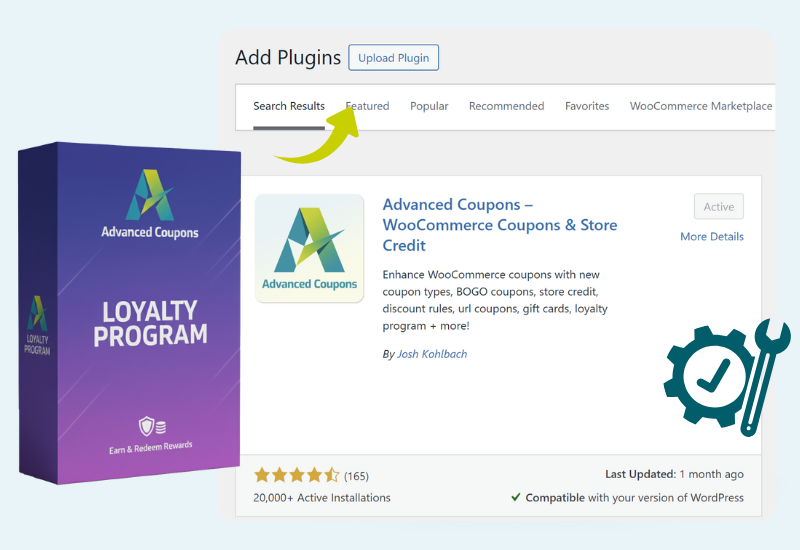
Grab the Advanced Loyalty Program plugin file from your account on advancedcouponsplugin.com, then upload it to your WordPress site under Plugins → Add New → Upload Plugin. Activate it the same way you would any other WooCommerce extension.
If you haven’t already installed the free Advanced Coupons plugin, do that first. Advanced Loyalty Program runs on top of it and uses the Store Credits feature from Advanced Coupons to handle point redemptions. Once both plugins are active, you’ll see a new Loyalty Program entry under your Coupons menu in the WordPress admin.
Practical tip: Before making your program visible to shoppers, finish configuring both your earning and redemption ratios. This keeps your points messaging aligned with the rewards customers can actually earn.
Step 2: Set your price-to-points-earned ratio
Head to Coupons → Loyalty Program → Settings → General. The first field, Price to points earned ratio, determines how many points a customer earns per dollar spent. Setting a ratio of 1 point per $1 spent means a $50 order earns 50 points.
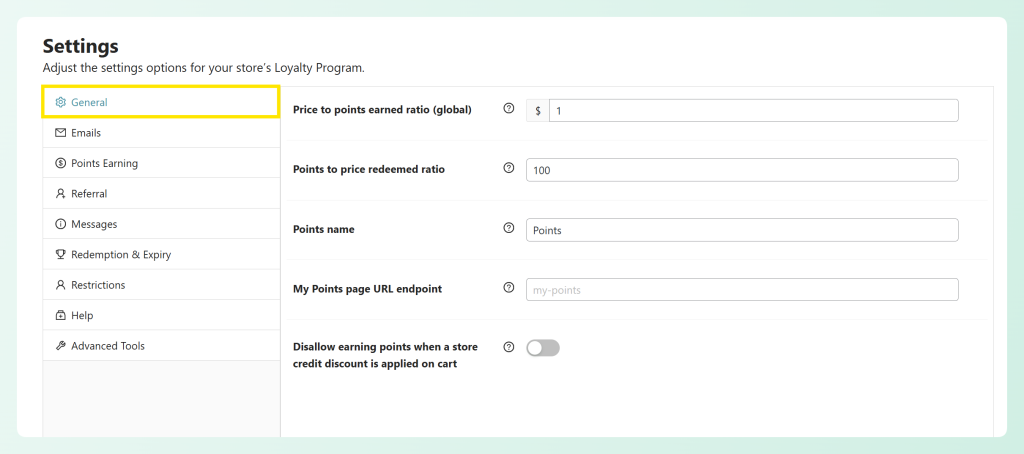
You can adjust this ratio to match your margins. Some stores offer 2 or 3 points per dollar to make the program feel more rewarding, then set a higher redemption threshold to balance it out. The important thing is that the math works for your business.
Here’s what this looks like in practice (example data):
| Earning Ratio | $50 Order Earns | $100 Order Earns |
|---|---|---|
| 1 point per $1 | 50 points | 100 points |
| 2 points per $1 | 100 points | 200 points |
| 5 points per $1 | 250 points | 500 points |
Higher point-per-dollar ratios make customers feel like they’re earning faster, which increases engagement. Just make sure you pair it with a redemption ratio that keeps your discount exposure manageable.
Step 3: Configure your points-to-price-redeemed ratio
Stay on the same screen (Coupons → Loyalty Program → Settings → General) and look for the Points to price redeemed ratio field directly underneath. This setting controls how much each point is worth when a customer cashes in, which is where you control your actual discount exposure.
For example, if you set the redemption at 10 points = $1, a customer who earned 100 points from a $100 purchase (at 1 point per $1) gets a $10 reward. That’s effectively a 10% return, which is generous but sustainable for most product margins.
Here’s a quick formula to calculate your effective discount percentage:
Effective discount = (Earning ratio / Redemption ratio) x 100
So if customers earn 1 point per $1 and redeem at 10 points = $1, your effective discount is (1/10) x 100 = 10%.
Adjust these two ratios together until you find a balance that feels rewarding to customers without eating too deep into your margins. A conservative starting point is usually easier to test and refine than launching with a very generous reward value right away.
If you want to pressure-test the numbers first, our ecommerce rewards program launch plan walks through the break-even math and a 90-day rollout timeline.
Step 4: Name your points and set earning rules
On the same Settings → General tab, find the Points name field. Give your points a custom name that fits your brand. Instead of generic “points,” you can call them “Reward Stars,” “Store Coins,” or whatever matches your branding. This name appears everywhere customers interact with the program.
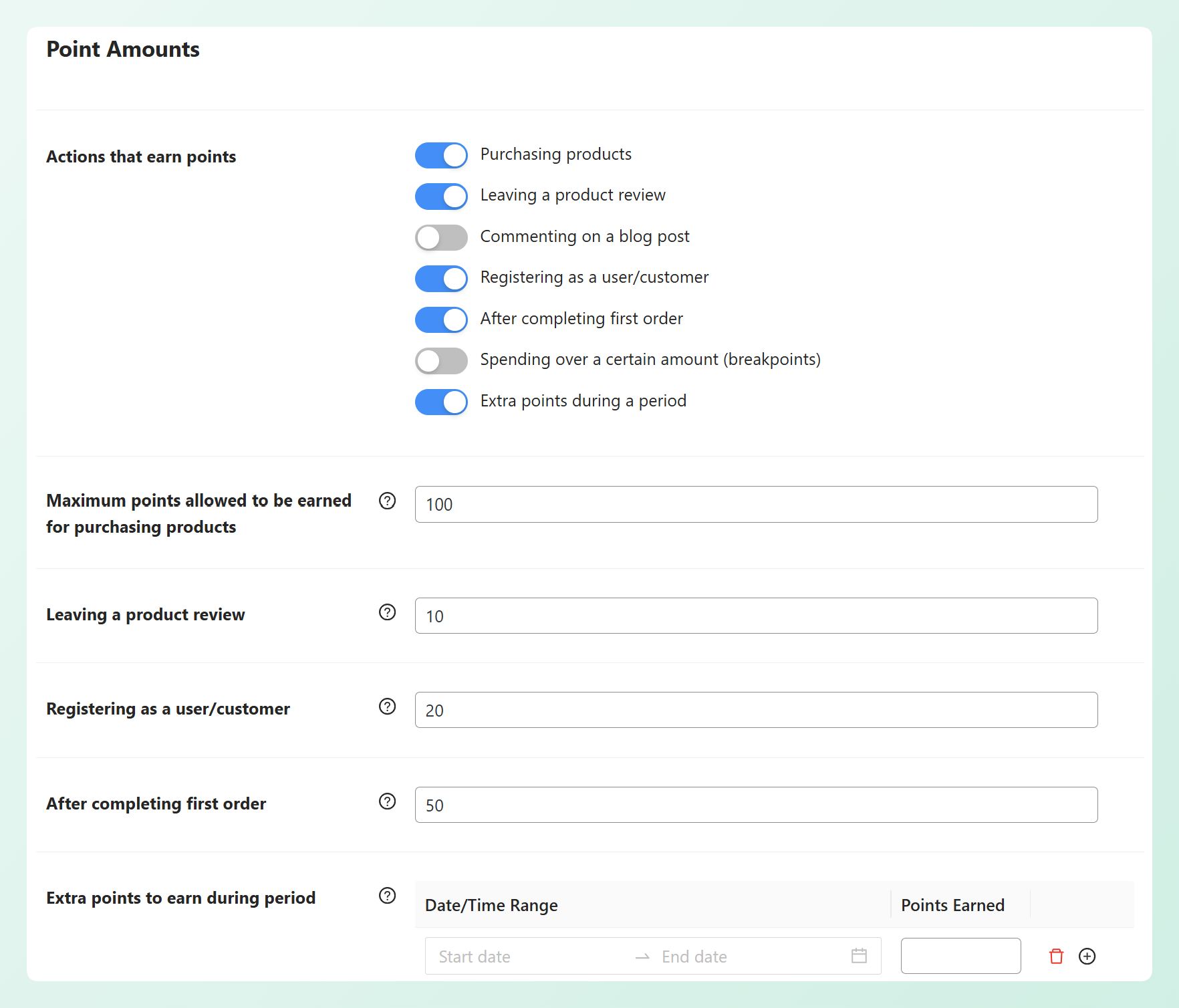
Next, switch to the Points Earning tab. Under Actions that earn points, you’ll find toggles for each customer action that can award points:
- Purchasing products: The core earning action. Points are calculated from the ratio you set in Step 2.
- Registering as a user/customer: Award points when a new customer creates an account. This incentivizes signups and gives you marketing data.
- Leaving a product review: Reward customers for leaving reviews. This builds social proof while keeping your loyalty program active between purchases.
- Commenting on a blog post: Award points for engaging with your content. This works well if your store has an active blog.
- Spending over a certain amount (breakpoints): Offer bonus points when an order exceeds a specific amount. This directly encourages higher cart values.
- After completing first order: Give new customers a welcome bonus to get them started in the program.
- Extra points during a period: Award bonus points on orders placed within a date range you set. This is useful for running limited-time double-points events without changing your base earning ratio.
Each action has its own toggle and its own point value, so you can mix and match. For example, you might award 50 points for a product review and 10 points for account registration.
Practical tip: Start with purchase points and product reviews before adding too many earning actions at once. Reviews are especially useful because they help keep customers engaged while also building social proof for future shoppers.
Step 5: Customize messages and set point expiration
Open the Messages tab under Coupons → Loyalty Program → Settings. This is where you control the messages customers see about their points on product pages, in the cart, and during checkout. Customizing these is important because they’re the primary way customers learn about and interact with your program.
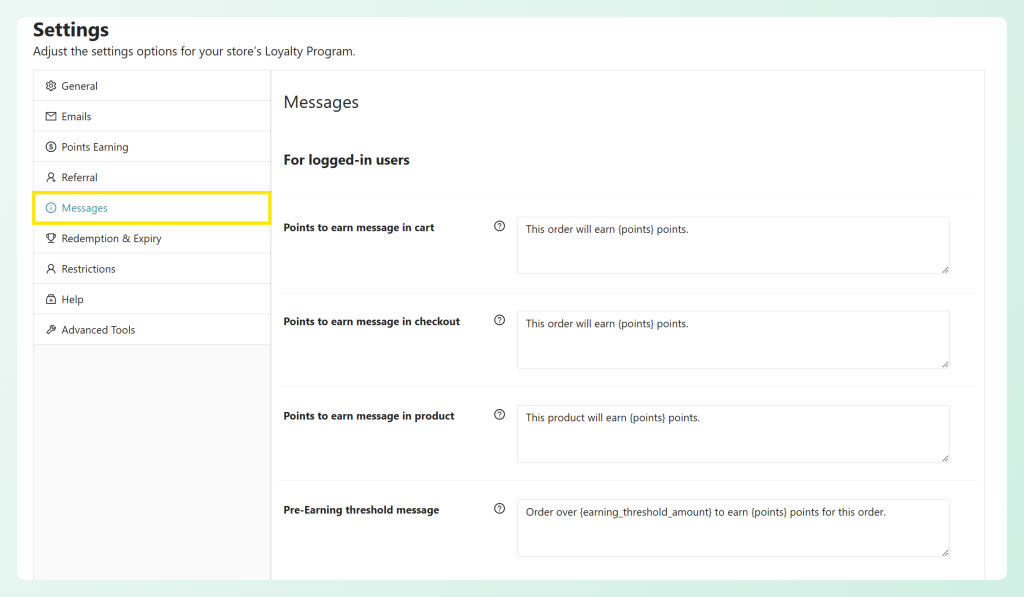
You can set different messages for:
- Product pages: Show how many points a customer will earn by purchasing that specific product.
- Cart page: Display total points earned for the current cart contents and the customer’s existing balance.
- Checkout page: Remind customers of their points and offer redemption right before payment.
- Guest vs. registered customers: Show different messaging to encourage account creation from guest shoppers. The plugin includes separate guest-only message fields, plus a toggle to hide all points messaging from guests if you prefer.
Next, jump to the Redemption & Expiry tab and find the Points expire after days inactivity field. The value is in days, so a 6-month window means entering 180, and a 12-month window means 365. Expiring points can create urgency and encourage customers to return before their balance disappears.
If you sell consumable products that customers reorder monthly, a shorter window of 90 to 180 days makes sense. For stores with longer buying cycles like furniture, electronics, or specialty goods, 365 days gives customers enough time to accumulate and use their rewards.
Practical tip: Customize the default points messages before launch. A message like “Earn 50 Reward Stars with this purchase!” is clearer and more brand-specific than a generic points notice.
Step 6: Set up your referral program
Switch to the Referral tab inside Coupons → Loyalty Program → Settings. Advanced Loyalty Program includes a built-in referral system that turns your existing customers into a growth channel. Customers get a unique referral link from their My Account page and earn points when their friends take action.
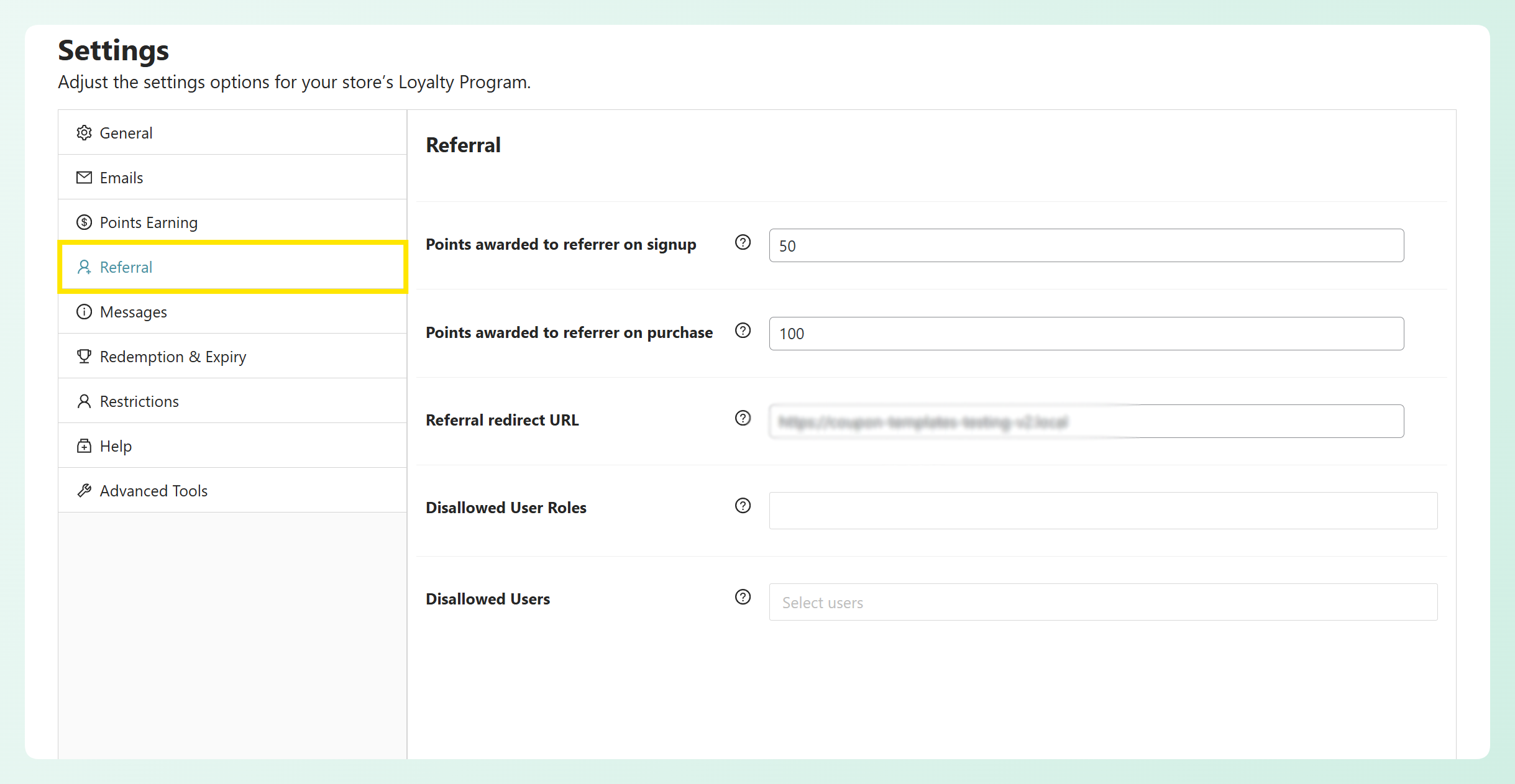
You can award referral points for two events:
- Points awarded to referrer on signup: Set a point reward for when the referred person creates an account. This is a low-friction action that expands your customer base.
- Points awarded to referrer on purchase: Set a point reward for when the referred person completes a purchase. This is the higher-value action since it generates actual revenue.
Both fields default to zero, meaning referrals are off until you enter a value. Many stores reward both actions with different point amounts, giving a smaller reward for signups and a larger one for completed purchases.
After completing all six steps, your WooCommerce loyalty points program is live. Customers can start earning points on purchases and non-purchase actions, see their balance in their account, and redeem points at checkout.
Managing Your Loyalty Program After Launch
Setting up the program is only the first part. Here’s how to manage it effectively once customers start earning points.
Track performance with the admin dashboard
The plugin includes a built-in insights dashboard that shows total points issued, total points redeemed, and your top-earning customers. Use this data to understand how actively your customers are engaging with the program. You can also ask an AI assistant to pull loyalty reports and top customers without opening the dashboard.
Key metrics to watch:
- Redemption rate: What percentage of earned points are actually being redeemed? A very low rate might mean customers don’t understand how to use their points or the rewards aren’t compelling enough.
- Points liability: Outstanding unredeemed points represent a future discount obligation. Keep an eye on this balance so it doesn’t grow uncontrollably.
- Top customers: Identify your most loyal buyers and consider giving them extra attention through manual point bonuses or personalized outreach.
Handle edge cases and exceptions
The plugin gives you several tools for managing exceptions:
- Manual point adjustments: Add or subtract points from any customer account. Use this for resolving support issues, correcting errors, or rewarding VIP customers outside the normal earning rules.
- Product and category exclusions: Exclude specific products or categories from earning points. This is useful for loss-leader items, already-discounted products, or high-margin items where you don’t want to stack additional discounts.
- User role restrictions: Exclude admin accounts, wholesale customers, or any other user role from the loyalty program. This prevents internal accounts from accumulating points.
For a deeper look at tracking the right numbers, see our guide on loyalty program KPIs.
Tips For Getting The Most From Your WooCommerce Loyalty Points
A loyalty program only works if customers actually participate. Here are practical strategies to increase engagement after launch.
Promote the program on every touchpoint
Don’t assume customers will discover your loyalty program on their own. Mention it in your order confirmation emails, on your homepage, and in your checkout flow. The points messaging you configured in Step 5 handles the on-site experience, but you should also promote it through your email marketing and social media.
Use bonus point events to drive urgency
Run limited-time “double points” events during slow sales periods. Since you control the earning ratio, you can temporarily increase it for a weekend or holiday period to drive purchases without running a traditional sale. This maintains your brand’s pricing integrity while still giving customers a reason to buy now.
Pair loyalty points with other coupon strategies
WooCommerce loyalty points work well alongside other promotional strategies. Since the Loyalty Program plugin is part of the Advanced Coupons ecosystem, you can combine it with cart conditions, BOGO deals, and scheduled coupons. For example, you could run a BOGO promotion that also awards bonus loyalty points on qualifying orders.
For ideas on pairing strategies, check out our guide on how to increase average order value.
Avoid common loyalty program mistakes
The most common mistakes we see with WooCommerce loyalty points programs are:
- Setting the discount too high: A very generous reward value can affect margins quickly, especially on high-volume items. Start conservative and increase the value later if engagement is low.
- Ignoring the expiration policy: Without expiration, points liability grows indefinitely. Set a reasonable window and communicate it clearly.
- Not tracking results: Launch the program and then monitor your repeat purchase rate, average order value, and customer lifetime value. If these aren’t improving after 60 to 90 days, revisit your configuration.
We’ve written a more detailed breakdown of pitfalls in our loyalty program mistakes and how to fix them guide.
How Customers Experience Your Loyalty Points Program
Understanding the customer-facing experience helps you optimize your setup. Here’s what your shoppers see after you’ve configured the program.
Earning points on product and cart pages
On every product page, customers see a message showing how many points they’ll earn with that purchase. The cart page shows the total points for all items. This visibility is key because it reminds customers of the reward they’re building toward with every purchase.
Redeeming points at checkout and My Account
Customers can redeem their points in two ways. First, they can go to the “My Points” section in their My Account dashboard and convert points to store credit at any time. Second, they can redeem directly at checkout when placing an order. Points convert automatically to store credit, which is applied to the order total. No coupon codes are required. Customers can also use their points to claim products and coupons as rewards.
Sharing referral links
If you’ve enabled the referral program, customers will see their unique referral link in their My Account area. They can share this link with friends via email, social media, or direct message. When a friend uses that link to sign up or make a purchase, the referring customer earns points automatically.
Frequently Asked Questions
Does WooCommerce have a built-in loyalty points system?
No. WooCommerce does not include a native loyalty points system. You need a dedicated plugin like the Advanced Loyalty Program to add points earning, redemption, and reward tracking to your store. The plugin works alongside WooCommerce’s existing coupon system.
How do customers redeem loyalty points in WooCommerce?
With the Advanced Loyalty Program, customers redeem points through their My Account dashboard or directly at checkout. Points convert automatically to store credit, which is applied to the order total. No coupon codes are needed.
Can I reward customers for actions other than purchases?
Yes. The Advanced Loyalty Program supports earning points for product reviews, blog comments, account registration, referrals, and spending above a set threshold. You can toggle each action on or off and assign custom point values.
Should loyalty points expire?
Setting an expiration period is recommended. It creates urgency and encourages customers to return sooner. The Advanced Loyalty Program lets you set a custom expiration period for points. Most stores use 6 to 12 months, depending on their typical purchase cycle.
Can I exclude certain products or categories from earning points?
Yes. The plugin lets you exclude specific products or entire product categories from earning points. You can also restrict earning by user role, which is useful if you want to exclude admin accounts or wholesale customers from the loyalty program.
How do I set up a referral program alongside loyalty points?
The Advanced Loyalty Program includes a built-in referral system. Customers get a unique referral link from their My Account page. You can award points when a referred friend registers, makes a purchase, or both. Point values for each referral action are customizable. For a detailed walkthrough, see our WooCommerce referral program setup guide.
Can I manually adjust a customer’s points balance?
Yes. Store admins can manually add or subtract points from any customer account. This is helpful for resolving support issues, rewarding VIP customers, or correcting mistakes. The plugin logs all manual adjustments for accountability.
How much does the Advanced Loyalty Program cost?
The Loyalty Program plugin starts at $99.50 per year for a single site (Growth plan). The Business plan covers unlimited sites at $199.50 per year. Both include all loyalty features, referral tracking, and admin tools. There’s also an All Access Bundle at $249 per year that includes the Loyalty Program alongside Advanced Coupons Premium, Advanced Gift Cards, and Advanced Promo Kit. See the full pricing details.
Start Rewarding Your Customers With WooCommerce Loyalty Points
A WooCommerce loyalty points program gives your store a built-in mechanism for encouraging first-time buyers to return. Instead of relying entirely on paid ads and one-off discount codes, you create ongoing value that grows with every purchase.
Here’s a recap of what to do:
- Understand why loyalty points matter and how they affect repeat purchases, order value, and retention
- Follow the 6-step setup process to configure earning ratios, redemption values, earning actions, messaging, and referrals
- Monitor your program using the admin dashboard and track redemption rate, points liability, and top customers
- Optimize engagement by promoting the program on every touchpoint and running bonus point events
- Review the customer experience to make sure points earning, redemption, and referral sharing are working smoothly
Ready to set up WooCommerce loyalty points for your store? Get the Advanced Loyalty Program and have your rewards system running today.



Can I add points to someone’s account? Can I set a certain amount of points for leaving a product review?
Hi Rhonda,
We’re about to release a new version that has a better admin dashboard and full admin facilities for adding custom amounts of points to someone’s account ad-hoc.
There’s also an option to have them earn points for leaving a product review (this is a feature already in the current version so you can do this today).
Hope this helps! You’re welcome to reach out if you have any pre-sales questions!
Is the points ad-hoc now available? I am looking to launch my loyalty program, but I definitely have some awesome buyers that I would like to back date some awards to their account. Thanks!
Hi Kristi, we’re in final testing for our Loyalty Program add-on and will be releasing that soon (hopefully in early Q2). Adhoc points is definitely in there 🙂
Is it possible to add points to customers who refer friends to our website and make a purchase? So our customers get a unique referral link to send to friends that benefits the customer and their friend?
Hi Martin, this is something we are working in the future with the Loyalty Program add-on. At the moment the main way to earn points is from purchases. But there are also these other ways:
– Earn extra points on first order/account signup
– Earn bonus points for higher spend
– Earn points for leaving a review
– Earn points for leaving a blog comment
– Earn extra points during a given promotional period
We’re hoping to add extra earning options including the one you asked about soon.
Do you have a target date to include “referrals”?
Hi Ainara, no firm date as yet. But it’s high on our request list. I will add your name to it.
Hello is there a special page for users to see the log points that have been obtained ?
Thank you.
Hi Rian,
Currently you can see the balance via the user’s My Account page.
We’re about to release a full admin panel experience soon which will feature this plus loads more 🙂 Stay tuned!